
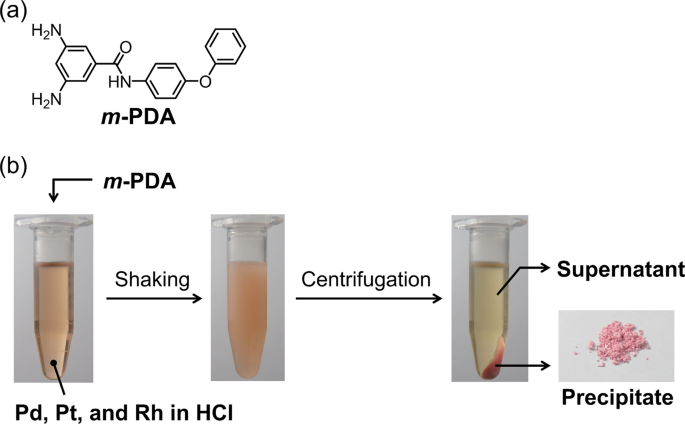
Materials
N,N-Dimethylacetamide (DMAc) was purchased from Wako Pure Chemical Industries Ltd. and distilled from calcium hydride before use. Thionyl chloride and NH4OH was purchased from Kanto Chemical Co., Inc., and used as received. 4-Phenoxyaniline was purchased from Tokyo Kasei Kogyo Co., Ltd. and used as received. m-PDA, 3-(Trifluoroacetamido)benzoic acid, and 4-(trifluoroacetamido)benzoic acid were prepared following methods reported in the literature32. Pd (II) and Pt (IV) standard solutions (1000 ppm in 1 M HCl) were purchased from Wako Pure Chemical Industries, Ltd. Rh (III) standard solution (1000 ppm in 1 M HCl) was purchased from Kanto Chemical Co., Inc.
Synthesis of m-MA
3-(Trifluoroacetamido)benzoic acid (0.63 g, 2.71 mmol) in thionyl chloride (10 mL) was refluxed for 3 h. Thionyl chloride was removed by distillation and then chloroform was added. After distillation of chloroform, the resulting product was dried in vacuo and dissolved in DMAc (5 mL). 4-Phenoxyaniline (0.45 g, 2.46 mmol) was added to the former DMAc solution and then the mixture was stirred for 12 h at room temperature, followed by for 1 h at 50 °C under nitrogen. To the solution was added water (0.35 mL) and the mixture was stirred for another 1 h at 50 °C. After the addition of hydrazine monohydrate (1.4 mL), the mixture was stirred for 4 h at 50 °C. Then the mixture was poured into a 5% NaHCO3 aqueous solution, and the resulting precipitate was collected by filtration, washed with water, and subsequently dried for 12 h at 80 °C in vacuo. The yield was 0.72 g (96%). 1H NMR (DMSO-d6, δ, ppm): 5.30 (s, 2H), 6.75 (d, J = 7.8 Hz, 1H), 6.98 (d, J = 7.5 Hz, 2H), 7.02 (d, J = 9.5 Hz, 2H), 7.05–7.17 (m, 4H), 7.37 (t, J = 7.5 Hz, 2H), 7.78 (d, J = 9.0 Hz, 2H), 10.08 (s, 1H). 13C NMR (DMSO-d6, δ, ppm): 112.94, 114.66, 116.72, 117.81, 119.25, 121.85, 122.89, 128.71, 129.90, 135.27, 135.88, 148.72, 151.81, 157.38, 166.19.
Synthesis of p-MA
p-MA was synthesized in the same manner as m-MA although 4-(trifluoroacetamido)benzoic acid was used instead of 3-(trifluoroacetamido)benzoic acid. The yield was 96%. 1H NMR (DMSO-d6, δ, ppm): 5.73 (s, 2H), 6.60 (d, J = 8.5 Hz, 2H), 6.98 (d, J = 8.0 Hz, 2H), 7.00 (d, J = 9.0 Hz, 2H), 7.10 (t, J = 7.5 Hz, 1H), 7.37 (t, J = 7.5 Hz, 2H), 7.72 (d, J = 8.5 Hz, 2H), 7.76 (d, J = 9.0 Hz, 2H), 9.78 (s, 1H). 13C NMR (DMSO-d6, δ, ppm): 112.53, 117.74, 119.22, 121.04, 121.73, 122.82, 129.26, 129.89, 135.70, 151.42, 152.06, 157.47, 165.13.
Metal precipitation experiments using m-PDA
To HCl solutions (1 mL) containing Pd (II), Pt (IV), and Rh (III) (1.0 mmol/L each) were added m-PDA, and the resulting mixtures were shaken vigorously at room temperature. After centrifugation (7200 g, 10 min), the metal concentrations in the supernatant were evaluated by ICP-AES. The HCl concentrations, the amount of precipitating agents, and the shaking time were changed in the metal precipitation experiments.
Rh precipitation experiments using m-MA and p-MA
To HCl solutions (1 mL) containing Rh (III) (1.0 mmol/L) were added m-MA or p-MA (9.1 mg, 0.03 mmol) and the mixtures were shaken vigorously at room temperature. After centrifugation (7200 g, 10 min), the Rh concentration in the supernatant was evaluated by ICP-AES. The HCl concentrations were changed in the Rh precipitation experiments.
Isolation of Rh-containing precipitate
To a HCl solution (2 M or 8 M, 10 mL) containing Rh (III) (2.0 mmol/L) were added m-PDA (64 mg, 0.2 mmol) and the mixture was shaken vigorously at room temperature. The resulting solid was collected by filtration and washed with a 2 M HCl solution. The solid was dried for 48 h at room temperature in vacuo.
Rh desorption experiments
To the Rh-containing precipitate (1.4 mg) was added a NH4OH solution (1 mL) and the mixture was shaken vigorously for 3 h at room temperature. After centrifugation (7200 g, 10 min), the Rh concentration in the supernatant was evaluated by ICP-AES. The concentrations of NH4OH were changed in the Rh desorption experiments.
Measurements
1H and 13C NMR spectra were recorded using a JEOL JNM-ECX 500 NMR spectrometer (Jeol Co., Tokyo, Japan). The metal concentrations were measured on an ICP-AES instrument (SPS5510, SII Nanotechnology Inc.). X-ray photoelectron spectroscopy (XPS) measurements were conducted on an AXIS-ULTRA X-ray photoelectron spectrometer (Kratos Analytical Ltd.). UV-Vis absorption spectra were collected using a UV-Vis spectrophotometer (Model V-550, Jasco co., Tokyo, Japan). Thermogravimetric analysis (TGA) measurements were carried out using a STA7300 (Hitachi High-Tech Science Co., Tokyo, Japan) at a heating rate of 10 °C min−1 under air flow (200 mL/min).