
Thermodynamic stabilization through molecular and metal–support interactions
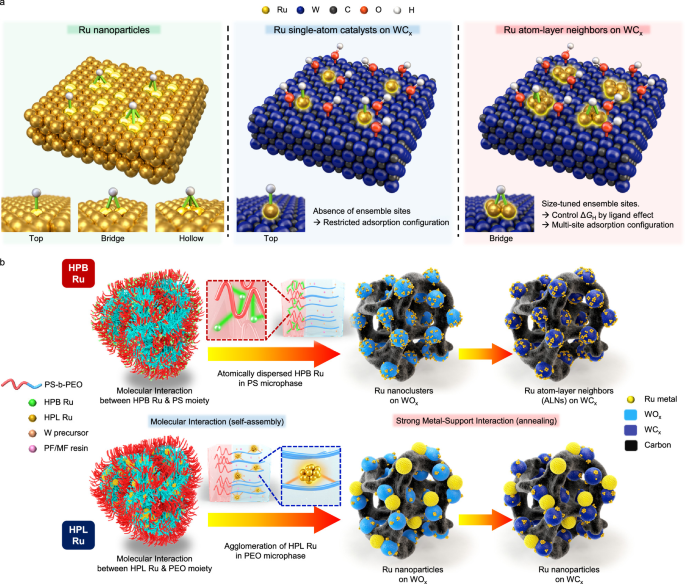
The alkaline HER is critical for both industrial applications and as a fundamental model for studying electrochemical reaction mechanisms. The alkaline HER requires two types of active sites in close proximity: one optimized for *H binding and the other for *OH binding48. This dual-site requirement makes it an ideal platform for evaluating the design characteristics of noble metal ALNs in electrocatalysis (Fig. 1a). Among noble metals, Ru is particularly well-suited for AEMWEs due to its adequate *H binding energy and high cost efficiency (~40 % of Pt; Supplementary Table 1). Transition metal carbides serve as effective functional supports for efficient alkaline HER. First, their favorable binding of oxygenated species provides sufficient *OH, a key adsorbate in various catalytic mechanisms13,49. Second, their strong affinity for noble metal species stabilizes the atomic structure of noble metal during both synthesis and catalytic processes13,36,50. Furthermore, their high electrical conductivity and chemical stability enhance the efficiency of electrocatalysis49.
Interaction mediator-assisted evaporation-induced self-assembly (EISA) using the BCP of poly(ethylene oxide)-block-poly(styrene) (PEO-b-PS) was employed for the synthesis of Ru ALNs on WCx32. During the EISA, metal precursors were selectively incorporated into specific BCP microphases based on their hydrophilicity. Since a thorough understanding of MIs within EISA systems was essential to achieve atomic dispersion of noble metal precursors, molecular dynamics (MD) simulations were conducted for both hydrophobic Ru precursor (HPB Ru, Bis(2-methylallyl)(1,5-cyclooctadiene)ruthenium(II)) and hydrophilic Ru precursor (HPL Ru, Ruthenium(III) chloride hydrate) to predict the spatial positioning and dispersity of Ru precursors during EISA. The polymer solvation energy (ΔEsolv) of each precursor was calculated to determine its location within the BCP. The calculations revealed that HPL Ru preferentially localizes within PEO microphases due to its favorable ΔEsolv for PEO (Supplementary Fig. 2, Supplementary Table 2). Conversely, HPB Ru localizes within PS microphases due to its favorable ΔEsolv for PS (Fig. 2a, Supplementary Figs. 2, Supplementary Table 2), consistent with the like-dissolves-like principle. The dispersion propensity of Ru precursors (ΔEdisp) in the polymer matrix was calculated as the difference between ΔEsolv and the self-solvation energy (Supplementary Fig. 3, Supplementary Table 3). HPL Ru exhibited unfavorable ΔEdisp in the PEO matrix due to its strong intermolecular interactions, which can be attributed to its ionic nature. This unfavorable ΔEdisp predicts its aggregation within the PEO microphase. Conversely, HPB Ru showed favorable ΔEdisp in the PS matrix, where polymer-precursor interactions exceeded intermolecular interactions, enabling atomic dispersion of HPB Ru in the PS microphase (Fig. 2a). The predicted precursor-polymer interactions were further supported by thermogravimetry analysis with differential scanning calorimetry (TGA-DSC) measurements, which revealed distinct thermal behaviors for the precursor/polymer composites compared with the corresponding individual components (Supplementary Note 2).

a Relationship between the polymer solvation energy (ΔEsolv) and dispersion propensity (ΔEdisp) of [Ru precursor], as calculated using molecular dynamics (MD) simulations. b Top-view snapshots from MD simulations of the equilibrated Ru ensembles on WC (RuN/WC) structures at 1200 K (orange: Ru, blue: W, gray: C). The insets show side views of the corresponding RuN/WC structures. c Standard deviation of Z-axis positional distribution of Ru species in RuN/WC structures as a function of the number of Ru atoms. XRD patterns of (d) samples prepared using hydrophobic Ru precursor (HPB Ru) (aRu5/WOx and aRu5/WCx) and (e) samples prepared using hydrophilic Ru precursor (HPL Ru) (aRu5p/WOx and aRu5p/WCx) (●: γ-WC [PDF 20-1316], ■: α-W2C [PDF 35-0776], ◊: Ru [PDF 88-1734]). The pale-yellow shaded regions highlight the crystalline Ru peaks. High-angle annular dark-field scanning transmission electron microscopy (HAADF-STEM) images and corresponding energy-dispersive spectroscopy (EDS) mappings of (f) aRu5/WOx, (g) aRu5/WCx, (h) aRu5p/WOx, and (i) aRu5p/WCx (red: Ru, blue: W, green: C).
To predict the atomic structure of Ru ensembles on WC (RuN/WC, N: the number of Ru) after high-temperature T (high-T) annealing at 1173 K, using the number of Ru atoms (NRu), MD simulations were performed at 1200 K. For Ru1/WC, the high surface energy of Ru SAC caused vigorous thermal migration onto the WC support (Supplementary Fig. 6a, Supplementary Movie 1a). From Ru2/WC to Ru163/WC, two-dimensional Ru ALNs (one-atom-thick layer) were thermodynamically stabilized by SMSI with WC. In this regime, the proximity of neighboring Ru significantly reduced the mobility of Ru ALNs (Fig. 2b, Supplementary Fig. 6b-j, Supplementary Movies 1–4, 5a). However, when NRu exceeded a critical threshold (NRu ≥ 235), the WC support could no longer stabilize Ru agglomerates as ALNs, resulting in the formation of three-dimensional Ru NPs (Fig. 2b, c, Supplementary Fig. 6k-m, Supplementary Movie 5b-d). By plotting the logarithm of NRu against the Ru-Ru coordination number (CN), we observed a transition in atomic structure from ALNs to sub-monolayer configurations and ultimately to NPs as NRu increased (Fig. 2c, Supplementary Fig. 7, Supplementary Table 6). These results indicated that only RuN/WC below a critical size (NRu < 235) can form stable Ru ALNs on WCx.
To investigate the effects of BCP-precursor systems and SMSI with WCx, aRuN/WCx (samples prepared via self-assembly using HPB Ru; N denotes the relative amount of Ru precursor) and aRu5p/WCx (sample prepared via self-assembly using HPL Ru with a Ru content similar to that of aRu5/WCx) were synthesized. For comparison, Ru on WOx (aRu5/WOx or aRu5p/WOx) was obtained by annealing at a lower T of 873 K to isolate the SMSI effect between Ru and WCx support. Additional comparison samples were prepared using incipient wetness impregnation (IWI) with HPB Ru (Ru/WCx) and HPL Ru (Rup/WCx), followed by low-T reduction at 473 K under 10 v/v% H2/Ar (_H2) and high-T annealing at 1,173 K under Ar (_Ar). Particulate Ru samples on supports were also synthesized by chemical reduction (_R) (see Catalyst synthesis in Methods). Theoretical predictions indicated that the spatial positioning and dispersity of Ru precursors were governed by MIs within EISA systems. HPB Ru exhibited atomic dispersion in PS microphases, while HPL Ru formed aggregates in PEO microphases (Fig. 1b). During thermal treatment, HPB Ru reduced to sub-nanoclusters, which subsequently stabilized as ALNs via SMSI with WCx due to their sufficiently small NRu (below the critical threshold). Furthermore, the limited mobility of Ru ensembles on WCx allowed for systematic tuning of ensemble size by adjusting the Ru precursor amount (Supplementary Notes 1–3). In contrast, large agglomerates of HPL Ru formed large Ru NPs, unable to stabilize as ALNs due to their large NRu.
To clarify the effect of MIs, Ru content in comparison samples was set to ~10 wt%, matching the Ru content in aRu5/WCx (Supplementary Table 7). Samples synthesized via self-assembly exhibited mesoporous structures with three-dimensional pore networks and large mesopores, as confirmed by N2 physisorption, small-angle X-ray scattering (SAXS), and scanning electron microscopy (SEM) (Supplementary Figs. 8–20). The relative volume fractions of hydrophilic and hydrophobic microphases are critical determinants of mesoporous morphology, indicating that porosity depends not only on the precursor amount but also on its hydrophilicity22. Consequently, even with the same molar amounts of Ru precursor, samples prepared with HPB Ru exhibited distinct porosity compared to those prepared with HPL Ru (Supplementary Fig. 20). Consistent with previous reports, these results suggest that the chemical affinity of the Ru precursors governs their preferential interactions with specific BCP microphases during the EISA process, thereby influencing mesostructural correlations, structural ordering and porosity evolution (Supplementary Note 5)51,52,53.
X-ray diffraction (XRD) analysis revealed the presence of crystalline WCx in all samples, except for aRu5/WOx and aRu5p/WOx (Fig. 2d, e, Supplementary Fig. 21, Supplementary Note 4). Notably, no crystalline Ru peaks were observed in either aRu5/WOx or aRu5/WCx, whereas aRu5p/WOx and aRu5p/WCx exhibited clear crystalline Ru peaks. This suggested that the MI of [PS-HPB Ru] effectively mitigated the MI of [HPB Ru], thereby facilitating the stabilization of Ru species as Ru ALNs (Supplementary Note 4). High-angle annular dark-field scanning transmission electron microscopy (HAADF-STEM) with energy dispersive spectroscopy (EDS) mapping of aRu5/WOx showed uniform Ru distribution without large agglomerates (Fig. 2f, Supplementary Fig. 22), while aRu5p/WOx exhibited uneven Ru dispersion with large agglomerates (Fig. 2h, Supplementary Fig. 24). These results showed that selecting an appropriate BCP-precursor system was crucial. This choice was particularly important for achieving uniform atomic dispersion of Ru species, and it required a detailed understanding of MIs within EISA.
STEM-EDS of aRu5/WCx revealed the uniform and selective dispersion of Ru ALNs on WCx supports, showing that the SMSI with WCx effectively prevented thermal sintering of Ru into NPs by maintaining Ru as ALNs (Fig. 2g, Supplementary Fig. 23). In comparison, aRu5p/WCx showed large Ru agglomerates, indicating that the SMSI with WCx was insufficient to stabilize large Ru agglomerates (exceeding the critical size threshold) as ALNs (Fig. 2i, Supplementary Fig. 25). Likewise, aRuN/WCx, synthesized via thermodynamic stabilization, exhibited the same features as aRu5/WCx in STEM-EDS, demonstrating the versatility of thermodynamic stabilization strategy for a wide range of Ru contents (~10 wt%) (Supplementary Figs. 26–29). Furthermore, the Ru atomic ratio Ru/(Ru+W) obtained from EDS analysis was in close agreement with the X-ray fluorescence (XRF) results, indicating that Ru is uniformly distributed throughout the sample via MIs, leading to consistent values between bulk (XRF) and local (EDS) analyses (Supplementary Figs. 22–30, Supplementary Table 7). In contrast, XRD and STEM-EDS of IWI-prepared samples revealed that IWI alone was insufficient to stabilize Ru ALNs, as it lacked mechanisms to mitigate MI of [Ru precursor], resulting in the formation of large agglomerates before annealing (Supplementary Figs. 19, 29–32, Supplementary Notes 4, 6).
Z-contrast imaging using high-resolution HAADF-STEM is widely applied to elucidate the atomic structure of noble metal on supports, as the brightness scales with both the atomic number (Z) and the number of atoms overlapped along the electron-beam direction54,55. However, in the case of Ru ALNs on WCx, tungsten (Z = 74) possesses a much higher Z than ruthenium (Z = 44), resulting in stronger intensity and making it difficult to distinguish Ru from the underlying W in thick WCx supports (>~2 nm). The simulated Z-contrast images for a single Ru atom and a single W defect on γ-WC ( ~ 0.6 nm thickness) exhibited similarly dark features (Supplementary Fig. 37a, b), indicating that such contrast cannot discriminate whether the dark spot originates from Ru or from a W vacancy. Furthermore, simulated Z-contrast images of RuN (N = 1-6) on γ-WC (~2 nm thickness) show nearly indistinguishable intensity profiles (Supplementary Fig. 38), suggesting that HAADF-STEM Z-contrast imaging is not suitable for resolving Ru ALN configurations on WCx supports.
Consistent with these simulations, experimental Z-contrast images of both aRu0/WCx (without Ru) and aRu3/WCx exhibited similar distributions of bright (red circles) and dark spots (Supplementary Fig. 37c, d), confirming the intrinsic difficulty in distinguishing atomically dispersed Ru from local contrast variations within the WCx lattice. In contrast, when Ru forms three-dimensional nanoclusters exceeding a critical size, the simulated image of Ru235/WC reveals distinguishable Ru features on the γ-WC lattice (Supplementary Fig. 39a) due to the increased Ru thickness and cumulative scattering along the beam path55. Similarly, experimental Z-contrast images of Ru/WCx_R (Ru nanoclusters on WCx supports, see Catalyst Synthesis in Methods and Supplementary Note 6) resolve sub-nanometer Ru aggregates (red circles, <1 nm) on WCx supports (Supplementary Fig. 39b). These results collectively indicate that HAADF-STEM Z-contrast imaging can reliably identify three-dimensional Ru nanoclusters, but cannot distinguish two-dimensional Ru ALN configurations on heavy WCx supports.
According to the Z-contrast image of aRu3/WCx, no three-dimensional sub-nanometer Ru aggregates were verified (Supplementary Fig. 37c). Electron energy-loss spectroscopy (EELS) line scans using atomic-resolution STEM across the Ru L-edge revealed a spatially compact grouping of Ru signals, typically consisting of two to three adjacent atomic-scale peaks, together with a cumulative increase in the integrated areal density along the scan path (Supplementary Fig. 40). This spatially correlated Ru signal evolution supports the presence of Ru ensemble sites on the WCx supports rather than isolated single atoms or three-dimensional aggregates.
Geometric and electronic structure of Ru atom-layer neighbors
To investigate the electronic and geometric structures of Ru ALNs, X-ray photoelectron spectroscopy (XPS) and X-ray absorption spectroscopy (XAS) were performed. During the transition from aRu5/WOx to aRu5/WCx, XPS showed a negative shift in Ru 3 d peaks (Supplementary Fig. 41a). Likewise, X-ray absorption near-edge structure (XANES) analysis at the Ru K-edge revealed a negative shift in the edge position for aRu5/WCx compared to aRu5/WOx (Fig. 3a). The edges of aRuN/WCx aligned closely to that of metallic Ru (Supplementary Fig. 58a). These indicated that the SMSI with WCx imparted metallic properties to Ru ALNs, which is distinct from those of comparison samples and previous findings of Ru SACs on various supports (Supplementary Figs. 41–58, Supplementary Note 7) 39,56,57.

a X-ray absorption near-edge structure (XANES) spectra at the Ru K-edge (Inset: enlarged view of the selected region of the main panel). b k2-weighted extended X-ray absorption fine structure (EXAFS) Fourier transform magnitude in R space (χ(R)) at the Ru K-edge of samples prepared using hydrophilic Ru precursor (HPL Ru) or hydrophobic Ru precursor (HPB Ru) with different annealing T (red shaded region: Ru-O interactions, blue shaded region: Ru-Ru interactions). k denotes the photoelectron wavenumber, and R denotes the radial distance in Fourier-transformed EXAFS R space. c Difference between the fitted Ru-W and Ru-Ru interatomic distances as a function of the coordination number (CN) of Ru-Ru interactions, based on EXAFS fitting results for the second shell at the Ru K-edge. Δl is defined as lRu-W – lRu-Ru, where lRu-W and lRu-Ru are Ru-W and Ru-Ru interatomic distances, respectively (Inset: enlarged view of the selected region of the main panel). d Overview wavelet transforms of aRu5/WCx and aRu5p/WCx at the Ru K-edge. e Detailed wavelet transform analyses of aRuN/WCx at the Ru K-edge second-shell region (red region: Ru-Ru interactions, blue region: Ru-W interactions). In d and e, R + ΔR denotes the radial coordinate used in the wavelet-transform maps. The inserted numbers indicate the CNs obtained from EXAFS fitting.
The Fourier transforms of extended X-ray absorption fine structure (FT-EXAFS) with corresponding fitting results reveal that aRuN/WCx was coordinated by ~4 Ru-C bonds (~0.1 Å longer than Ru-O) and ~2 Ru-W bonds, indicating that Ru ALNs were selectively stabilized on WCx supports (Fig. 3b, c, Supplementary Figs. 59, 67, Supplementary Tables 8, 9). In contrast, aRu5p/WCx and IWI-prepared samples exhibited ~2 Ru-O coordination in the first shell, which originated from surface oxygen bonds on Ru agglomerates58. Furthermore, the CN of Ru-Ru in aRuN/WCx gradually increased with higher Ru contents, suggesting that the Ru precursor amount systematically controlled the ensemble size of Ru ALNs (Fig. 3c, Supplementary Fig. 67, Supplementary Table 9). The Ru-Ru CN for aRuN/WCx ranged between 1.5 and 2.5, with distinct bond lengths of Ru-Ru (~2.74 Å) and Ru-W (~2.84 Å), which differed from those for Ru metal and Ru agglomerates in comparison samples (Fig. 3c, Supplementary Tables 8–11). The low Ru-Ru CN suggests that each Ru ALN consisted of six or fewer Ru atoms, and the distinct bond lengths likely result from two-dimensional atomic structures of Ru ALNs via SMSI with WCx supports (Supplementary Table 6, Supplementary Note 8) 59. The FT-EXAFS with corresponding fitting for aRu5p/WCx and IWI-prepared samples revealed the presence of large Ru or Ru-W alloy agglomerates (Fig. 3b, c, Supplementary Tables 8–10, Supplementary Note 8).
Because HAADF-STEM analyses provide highly local structural information, they cannot alone verify whether the Ru ALN configuration represents the dominant structure across the catalyst. To address this, we compared the structural parameters predicted by theory with those obtained from bulk-averaged EXAFS fitting. Because the DFT models represent idealized local structures and do not fully capture the heterogeneity and dynamic electrochemical environment of the catalyst under operating conditions, the calculations are used mainly to support trends and guide the interpretation of the experimental results. Density functional theory (DFT) calculations suggested that two-dimensional RuN clusters are thermodynamically more favorable than their three-dimensional counterparts (Supplementary Figs. 68, 69). This trend is consistent with our MD simulations, in which three-dimensional RuN clusters were spontaneously stabilized into ALN structure below a critical size (NRu < 235) (Supplementary Fig. 6, Supplementary Movies 1–5). The theoretically predicted Ru-Ru bond lengths of RuN/WCx (Supplementary Fig. 70) are consistent with those obtained from EXAFS fitting for aRuN/WCx (~2.74 Å), but not with those of NP-based samples (~2.67 Å; Rup/WCx_H2, Ru/WCx_H2, Ru/WCx_R, Ru/C_R). This characteristic elongation of the Ru-Ru distance is a distinctive signature of the ALN geometry. Furthermore, the experimentally observed Ru-Ru bond length elongation is inconsistent with both residual RuOx species and incompletely dispersed Ru clusters and is more consistent with Ru ALN structures stabilized through simultaneous Ru-C and Ru-W coordination on WCx (Supplementary Note 9).
Furthermore, the ensemble-size-dependent variation in the Ru-W CN obtained theoretically using a cutoff of <2.90 Å closely follows the experimental trend observed for aRuN/WCx, whereas the trend calculated using a cutoff of <2.70 Å does not (Supplementary Fig. 80a, b). Consistently, the Ru-W bond length extracted from EXAFS for aRuN/WCx (Supplementary Fig. 80e) differs from that of alloy-type Ru-W NP samples (~2.72 Å; aRu5p/WCx, Ru5p/WCx_Ar, Ru5/WCx_Ar), reflecting the distinct coordination environment imposed by the two-dimensional Ru ALN structure (Supplementary Note 8). The consistency between the theoretical trends and experimentally obtained structural parameters supports the assignment of Ru ALNs as a predominant structural motif in aRuN/WCx.
Taken together, the Ru ALN model is consistent with the experimentally observed structural fingerprints, including the characteristic Ru-Ru bond-length elongation, the distinctive Ru-W coordination environment, direct Ru-C anchoring interactions, and their ensemble size-dependent evolution. The consistency between theory and experiment across these independent structural descriptors supports that Ru species in aRuN/WCx are predominantly stabilized as Ru atom-layer neighbors on WCx supports (Supplementary Note 8).
In wavelet transforms of EXAFS (WT-EXAFS), aRuN/WCx exhibited an intensity maximum at lower k compared to RuO2 and Ru agglomerates in comparison samples, within the k range of 3 to 6 Å−1 (Fig. 3d, Supplementary Figs. 84, 85). This lower k suggests that coordinating atoms in the first shell of aRuN/WCx are lighter than oxygen, potentially indicating the presence of carbon (Supplementary Note 8)60. To further distinguish the contributions of Ru-Ru and Ru-W in the second shell of aRuN/WCx, a detailed WT-EXAFS analysis that offers higher resolution in k-space at the expense of R-space resolution was conducted (Fig. 3e, Supplementary Note 8). The lower k region (red square) corresponds to Ru-Ru, while the higher k region (blue square) corresponds to Ru-W. The relative intensity of Ru-Ru compared to Ru-W increased as Ru contents increased, which reflects the systematic tuning of ensemble size by adjusting the Ru contents. In conclusion, the thermodynamic stabilization strategy successfully stabilized Ru ALNs with distinct atomic structures via MIs and SMSI with WCx, enabling systematic control over the ensemble size of Ru ALNs.
Origin of the enhanced kinetics for Ru atom-layer neighbors
To evaluate the Gibbs free energy of hydrogen binding (ΔGH) based on the geometric structure of noble metal species, DFT calculations were performed. The ideal ΔGH value for efficient HER is ~0 eV. Consistent with previous studies, hollow sites of Pt (111) and Ru (0001) provided the most stable *H adsorption, with ΔGH for Ru (0001) calculated to be −0.269 eV (Fig. 4a, b, Supplementary Figs. 88, 90a, Supplementary Table 15). In contrast, isolated single-atom Ru on WC support (Ru1/WC) exhibited only top-site adsorption with ΔGH of 0.320 eV. Ru ALNs on WC support enabled bridge-site adsorption of *H when neighboring Ru atoms were present. Notably, despite identical bridge-site adsorption, the ΔGH of Ru ALNs varied with the number of Ru atoms in the Ru ALN, which can be attributed to the ligand effect from neighboring Ru atoms. In particular, Ru3/WC and Ru4/WC exhibited near ideal ΔGH values of −0.239 eV and −0.211 eV, respectively. Furthermore, WCx supports showed favorable Gibbs free energy for oxygenated species, such as *OH and *H2O, facilitating the enrichment of *OH species near *H binding sites (Supplementary Figs. 89, 90b, Supplementary Table 16).

a Density functional theory (DFT)-optimized *H adsorption configuration on various catalysts. b Absolute values of ΔGH for Ru ensembles on WC (RuN/WC) structures. c Linear sweep voltammetry (LSV) curves, and d corresponding Tafel slope (red) and j per noble metal mass at −50 mV (vs. reversible hydrogen electrode (RHE)) for alkaline hydrogen evolution reaction (HER) in H2-saturated 1 M KOH solution. e, Relative current retention (%) during chronoamperometry at an overpotential of 50 mV over 80,000 s. f Chronopotentiometry for long-term durability test of aRu3/WCx (0.100 mgRu cm−2) in 1 M KOH solution. The RDE polarization curves were iR-corrected using the EIS-derived uncompensated solution resistance measured before each experiment (Ru = 5.5 ± 1.5 Ω). The corresponding non-iR-corrected polarization curves are provided in Supplementary Fig. 91 f.
Under the alkaline conditions (H2-saturated 1 M KOH), the HER activity of aRuN/WCx showed a volcano-type dependence on the ensemble size of Ru ALNs, with aRu3/WCx achieving the lowest overpotential for −10 mA cm−2 (η10) at 22 mV (potentials referenced to the reversible hydrogen electrode, RHE) and Tafel slope of 41.9 mV dec−1 (Fig. 4c, d, Supplementary Figs. 91, 92, Supplementary Tables 17, 18). Similarly, the trend in kinetic activity remained consistent at an identical Ru loading of 0.042 mg cm−2 (Supplementary Fig. 93). Furthermore, aRu3/WCx (−1202.0 mA mgmass−1), showed a higher current density at an overpotential of 50 mV per noble metal mass (j50/mass) than commercial Pt/C, which displayed η10 of 42 mV, a Tafel slope of 81.9 mV dec−1, and j50/mass of −312.0 mA mgmass−1 at 50 mV under identical noble metal loading (0.042 mg cm−2). DFT calculations (Fig. 4a) suggest that the enhanced activity of aRu3/WCx within the aRuN/WCx series is associated with the ensemble-size-dependent modulation of *H binding, consistent with Ru3/WCx or Ru4/WCx-like local structures being major contributors to the observed activity (Supplementary Note 10). By contrast, Ru NPs and agglomerates in comparison samples exhibited lower performance due to unfavorable ΔGH values or lower noble metal utilization efficiency of particulate Ru (Fig. 4c, d, Supplementary Figs. 91, 92, Supplementary Table 17). During the long-term chronoamperometry at an overpotential of 50 mV, aRu3/WCx showed a smaller decrease in activity than the comparison catalysts tested under the same conditions, showing only about half the current density loss of commercial Pt/C and other comparison catalysts (Fig. 4e, Supplementary Fig. 95). To minimize the mechanical and hydrodynamic effects induced by electrode rotation, the durability test was conducted using aRu3/WCx coated onto carbon paper, which is a typical substrate for durability assessment39,61. During the 100 h chronopotentiometry, aRu3/WCx exhibited only minor voltage losses of ΔV ≈ 0.009 V at −200 mA cm−2 and ΔV ≈ 0.050 V at −500 mA cm−2 without any noticeable initial current decrease, owing to the SMSI between Ru ALNs and WCx supports (Fig. 4f). The post-durability analyses confirmed that aRu3/WCx preserved its mesoporous morphology and atomic-scale Ru dispersion after the long-term durability test, without forming the large Ru agglomerates (Supplementary Figs. 96, 97).
To examine the general applicability of the present ALN stabilization strategy, aPt3/WCx and aIr3/WCx were synthesized using hydrophobic Pt and Ir precursors, dimethyl(1,5-cyclooctadiene)platinum(II) (HPB Pt) and ((1,5-cyclooctadiene)-η5-indenyl)iridium(I) (HPB Ir), respectively, under identical noble metal molar loading conditions to those used for aRu3/WCx (Supplementary Note 11). Structural analyses revealed that Ir could be stabilized as ALN-like structures on WCx through the same stabilization mechanism, whereas Pt formed partially aggregated nanoclusters anchored on WCx (Supplementary Figs. 98–105, Supplementary Table 19). These different stabilization behaviors suggest that thermodynamically favorable noble metal-WCx interactions alone are insufficient for well-defined ALN formation, and that precursor-directed MIs during EISA are critical for suppressing premature aggregation and enabling surface confined ALN structures. The alkaline HER activities of the resulting catalysts were additionally evaluated at identical noble-metal loadings (42 μg cm−2). aPt3/WCx exhibited an η10 of 26 mV and a Tafel slope of 25.8 mV dec−1, comparable to those of aRu3/WCx, whereas aIr3/WCx showed relatively lower HER activity with η10 of 51 mV and a Tafel slope of 97.2 mV dec−1 (Supplementary Fig. 106).
To reveal the origin of the enhanced kinetic activity of aRu3/WCx, in situ XAS analyses were conducted under alkaline HER conditions (Fig. 5a-d). To monitor the potential-dependent structural evolution, in situ XANES and FT-EXAFS spectra were collected at both the W L3-edge and Ru K-edge under a series of stepwise applied potentials, from open-circuit potential (OCP) to −50 mV (vs. RHE) with 10 mV intervals. At the W L3-edge, the white line intensity of aRu3/WCx increased when an overpotential was applied compared to that at the OCP (Fig. 5a), indicating an increase in the oxidation state of W. Likewise, the intensity of the first-shell peak in the corresponding FT-EXAFS spectra also increased under HER operation (Fig. 5b), suggesting a rise in the W-O/C CN. These results imply that the surface of WCx supports becomes enriched with oxygenated species (e.g., *OH or *O) during alkaline HER, consistent with previous reports62,63. In contrast, at the Ru K-edge, the edge position of aRu3/WCx was negatively shifted relative to that at the OCP (Fig. 5c), indicating a partial reduction of Ru species due to *H adsorption on the Ru active sites64. Moreover, no noticeable change was observed in the FT-EXAFS spectra at the Ru K-edge (Fig. 5d), suggesting that the Ru ALN structure remained intact during HER, maintaining its ALN configuration throughout the reaction.

In situ (a) XANES (Inset: enlarged view of the selected region of the main panel) and (b) corresponding Fourier-transformed extended X-ray absorption fine structure (FT-EXAFS) spectra at the W L3-edge of aRu3/WCx at different potentials. In situ (c) XANES (Inset: enlarged view of the selected region of the main panel) and (d) corresponding FT-EXAFS spectra at the Ru K-edge of aRu3/WCx at different potentials. In (b and d), R denotes the radial distance in Fourier-transformed EXAFS R space. e In situ Raman spectra collected at sequential potentials (green shaded region: the coupled O=W···W-OH mode (~1060 cm−1)). f Difference contour map generated from the in situ Raman spectra, showing the potential-dependent evolution of Raman intensity. g In situ attenuated total reflection surface-enhanced infrared absorption spectroscopy (ATR-SEIRAS) spectra of aRu3/WCx at sequential potentials. h Comparison of in situ ATR-SEIRAS spectra at -0.050 V for Pt/C and aRu3/WCx. All potentials are referenced to the reversible hydrogen electrode (RHE).
To identify the surface species formed on the WCx supports, in situ Raman spectroscopy was performed at OCP and under sequentially applied potentials ranging from 0.100 V to −0.300 V (vs. RHE) with 0.050 V intervals (Fig. 5e, f). The intensity of the Raman band centered at ~1060 cm−1 increased as the potential decreased from 0.100 V to 0.000 V relative to that at the OCP, and then remained nearly constant upon further decrease to −0.300 V. According to previous reports, Raman bands observed around ~1060 cm−1 are typically assigned to coupled O = W···W-OH vibrations in tungsten-based compounds65. Combining the in situ Raman and in situ XAS results, it can be concluded that the surface of the WCx supports becomes enriched with oxygenated species (e.g., *OH and *O) under alkaline HER conditions, consistent with the potential-dependent oxidation observed in the W L3-edge XAS. Such surface oxygenation behavior is consistent with previous reports that transition metal carbides possess inherently high oxygen affinity, leading to spontaneous adsorption of oxygenated species in the presence of water during the catalytic reactions49,66.
Previous research has identified that the depletion of water in the gap region, namely the gap water, causes sluggish alkaline HER kinetics by reducing the connectivity within the H-bond networks46. To investigate variations in the interfacial water structure across support materials, in situ attenuated total reflection surface-enhanced infrared absorption spectroscopy (ATR-SEIRAS) was employed. Peaks at 3600, 3400, and 3180 cm−1, assigned to the O-H stretching mode (νO-H) of water, can be attributed to weakly hydrogen-bonded, liquid-like, and ice-like water, respectively67. According to the electric double layer-based model, the 3600 cm−1 band corresponds to water molecules located in the interfacial gap region with partially disrupted hydrogen bonding, which act as bridging species linking the nearest interfacial water species and the bulk electrolyte46,68. Therefore, an increased population of gap water facilitates proton transfer between bulk water and inner Helmholtz layer through an improved H-bond network. During alkaline HER, the proportion of gap water for aRu3/WCx (17.4%) was significantly greater than that of Pt/C (Fig. 5g, h, Supplementary Fig. 107). This indicates that the *OH species on WCx supports significantly enhance the H-bond network connectivity by increasing the gap water population, thereby accelerating HER kinetics compared to Pt/C with carbon supports (Supplementary Note 12).
The electrochemical characteristics of aRu3/WCx are also distinct from those typically reported for hydrogen-spillover-dominated HER electrocatalysts69. Previous studies on hydrogen-spillover-based HER electrocatalysts have generally reported characteristic Tafel slopes of ~20−25 mV dec−1 associated with spillover-assisted HER kinetics70,71, whereas aRu3/WCx exhibited a larger Tafel slope of 41.9 mV dec-1 (Supplementary Fig. 91). In addition, hydrogen-spillover-based electrocatalysts often exhibit pronounced electrochemical hydrogen desorption features originating from substantial populations of spilled-over hydrogen species on the support surface71,72. In contrast, aRu3/WCx did not exhibit any noticeable hydrogen desorption peak in CV measurements (Supplementary Fig. 108), suggesting that substantial accumulation of spilled-over hydrogen species on the WCx support does not occur in our system. Taken together, these results support a mechanism in which the WCx support primarily enhances interfacial proton-transfer kinetics through H-bond network modulation, while the Ru ALNs remain the principal HER-active sites for hydrogen adsorption and H2 evolution.
To distinguish the effects of the active-site structure and WCx support, additional DFT calculations were performed for Ru ensembles supported on graphene and γ-WC models, together with Bader charge and ΔGH analyses (Supplementary Figs. 109, 110). Both the Bader charge and ΔGH values varied with the Ru ensemble size on both supports, indicating that neighboring Ru-Ru interactions significantly influence the electronic structure and hydrogen adsorption energetics of Ru active sites. Furthermore, Ru ensembles on γ-WC consistently exhibited lower Bader charge values and ΔGH values closer to the ideal hydrogen adsorption free energy than those on graphene, suggesting that additional electronic modulation can be induced through strong Ru-WCx interactions. These results suggest that both the Ru ensemble structure and the WCx support contribute to optimizing the hydrogen adsorption energetics for alkaline HER.
To experimentally distinguish the active-site structure effect and the WCx support effect, atomically dispersed Ru clusters on N-functionalized carbon (aRu/NC) with a Ru-Ru CN of 1.92 comparable to that of aRu3/WCx (CN = 1.72) were synthesized (Supplementary Figs. 111, 112). In addition, Ru NPs supported on WCx and carbon (RuNP/WCx and RuNP/C) were prepared to directly examine the support effect for similar NP active-site structures (Supplementary Figs. 113–115). During alkaline HER (Supplementary Fig. 116), aRu3/WCx exhibited substantially higher HER activity (η10: 22 mV, Tafel slope: 41.9 mV dec−1) compared with aRu/NC (η10: 128 mV, Tafel slope: 105.5 mV dec−1), despite their similar Ru coordination environments. Likewise, RuNP/WCx exhibited better HER activity (η10: 20 mV, Tafel slope: 30.8 mV dec−1) than RuNP/C (η10: 36 mV, Tafel slope: 52.1 mV dec−1), further confirming the beneficial role of the WCx support. These results collectively indicate that enhanced HER activity of aRu3/WCx originates from the cooperative effects of (i) optimized hydrogen adsorption energetics induced by both the Ru ensemble size and strong Ru-WCx interactions and (ii) enhanced proton-transfer kinetics arising from the favorable interfacial water structure provided by the WCx support compared with inert carbon supports (Fig. 5g, h, Supplementary Note 12).
At the same time, comparison between aRu/NC and RuNP/C further suggests that neighboring Ru-Ru interactions themselves also strongly influence HER activity under inert carbon supported conditions, as Ru NPs exhibited substantially higher activity than small Ru clusters supported on carbon. This trend is also consistent with the DFT results, which predict relatively non-ideal ΔGH values for low-coordination Ru ensembles on inert carbon supports compared with Ru ensembles stabilized on γ-WC (Fig. 4a, b, Supplementary Figs. 109, 110). Although RuNP/WCx and aRu3/WCx possess different active-site geometries, both catalysts exhibited high HER activity owing to the beneficial Ru-WCx interactions, together with the favorable interfacial water structure provided by the WCx support. However, unlike Ru NPs, all Ru atoms in the Ru ALN structures are directly stabilized through chemical interactions with WCx, enabling substantially stronger SMSI stabilization and consequently greater durability during long-term HER operation (Supplementary Fig. 116d).
Therefore, the DFT calculations, together with experimental control studies, support that the enhanced alkaline HER activity of Ru ALNs originates from the cooperative contributions of (i) electronic structure modulation induced by both neighboring Ru-Ru interactions and strong Ru-WCx interactions, (ii) adsorption-configuration changes enabled by neighboring Ru sites, and (iii) interfacial kinetic enhancement provided by the WCx support.
To sum up, aRu3/WCx exhibited higher kinetic activity than commercial Pt/C through two synergistic effects of dual-type sites (Ru ALNs for *H and WCx supports for *OH) revealed by theoretical calculations and in situ spectroscopic analyses. First, the OH-enriched WCx supports increased the population of gap water at the catalyst-electrolyte interface, which bridges the active sites and the bulk electrolyte, thereby restoring the H-bond network continuity and facilitating proton transfer across the interface. Second, the controlled ensemble size of Ru ALNs regulates the H-adsorption configuration and strength through cooperative geometric coupling among adjacent Ru atoms and electronic interactions with the underlying WCx supports, maintaining a stable and highly active Ru configuration during alkaline HER operation. These cooperative effects provide a plausible explanation for the enhanced reaction kinetics of aRu3/WCx, as consistently demonstrated by the in situ XAS, Raman, and ATR-SEIRAS results (Fig. 5).
Single-cell performances of Ru atom-layer neighbors
aRu3/WCx provides an effective catalyst architecture for efficient, low-noble metal AEMWEs. The ALN architecture of Ru ALNs combines the advantages of both SACs and NP catalysts to maximize Ru utilization while creating a favorable environment for the HER. To assess the practical applicability of aRu3/WCx, single-cell performance was investigated under practical AEMWE operating conditions using 1 M KOH. Among the aRuN/WCx-based AEMWEs, the aRu3/WCx reached a current density of 9.82 A cm-2 at 2.0 Vcell and 80 °C with a low noble metal loading of 0.10 mgRu cm-2 (Fig. 6a, Supplementary Fig. 118, Supplementary Table 20). This result indicates that size-tuned Ru ALNs contribute to the increase in AEMWE performance under identical Ru loading (0.10 mgRu cm-2). Furthermore, the aRu3/WCx-based AEMWE with a lower noble metal loading (0.1 mgRu cm-2) achieved a comparable current density of 9.82 A cm-2 to the benchmark Pt/C-based AEMWE (9.77 A cm-2) with a higher noble metal loading of 0.4 mgPt cm-2 (Fig. 6b, Supplementary Figs. 117, 118, Supplementary Table 20). Owing to its lower noble metal loading and the comparatively lower cost of Ru, aRu3/WCx achieved 4.0 times higher mass activity (98.2 A mgmass−1) and 9.2 times higher specific activity (activity per unit price of noble metal, 5880.9 A EUR−1) compared with Pt/C (Fig. 6c, Supplementary Table 20). At 1.8 Vcell, aRu3/WCx reached 4.52 A cm-2 at 80 °C and 3.65 A cm-2 at a milder operating T of 60 °C (Fig. 6a) despite its low noble metal loading of 0.10 mgRu cm-2, exceeding US DOE’s 2026 performance target (3.0 A cm-2 at 1.8 Vcell) and ultimate noble metal loading target (0.125 mg cm-2) for PEMWEs73. Furthermore, the aRu3/WCx cathode reached 3.10 A cm-2, exceeding the DOE 2026 target performance even with a commercial AEM and AEI (PiperION-A) at 60 °C (Supplementary Fig. 120). Among reported AEMWE catalysts, aRu3/WCx demonstrated competitive specific activity and met both DOE targets even at low T of 60 °C (Supplementary Fig. 121 and Supplementary Table 21, DOE target of specific activity was calculated using Ru price).

a, Polarization curves of anion-exchange membrane water electrolyzers (AEMWEs) using aRu3/WCx (0.10 mgRu cm−2) and Pt/C (0.10 mgPt cm−2) with 1 M KOH electrolyte at operating T of 60 °C and 80 °C. b, Polarization curves of AEMWEs using aRu3/WCx (0.10 mgRu cm−2) and Pt/C (0.40 mgPt cm−2) under identical conditions. c, Comparison of mass activity and specific activity at 2.0 Vcell and 80 °C. The noble metal costs are detailed in Supplementary Table 1. d, Cell voltage profiles and corresponding H2 Faradaic efficiency during AEMWE operation (60 °C, 1 M KOH) at a constant current density of 1.0 A cm−2 for 100 h, with an identical noble metal loading of 0.10 mgmass cm−2. e, Polarization curves of AEMWEs before (BOT) and after (EOT) 100 h operation at 1.0 A cm−2. f, Corresponding cell voltage increases after 100 h operation at 1.0 A cm−2. g, Comparison of S-number obtained during 100 h operation at 1.0 A cm−2. h, Long-term durability test of AEMWEs operated for 500 h at a constant current density of 1 A cm−2 and 60 °C, using aRu3/WCx (0.10 mgRu cm−2, red) and commercial Pt/C (0.10 mgPt cm−2, gray; 0.40 mgPt cm−2, black). The inset shows a photograph of the AEMWE single-cell used for the long-term durability test. i, Corresponding cell voltage increase after 500 h operation at 1.0 A cm−2. The AEMWE polarization curves are shown without iR correction. All AEMWE voltages are reported as full-cell voltages (Vcell).
To compare the activity and durability of aRu3/WCx with those of commercial benchmark catalysts (Pt/C and Ru/C) at the single-cell level, AEMWE tests (1 M KOH, 60 °C) were performed under identical noble metal loading conditions (0.10 mgmass cm-2). Among the tested cathodes, aRu3/WCx delivered a current density of 8.30 A cm−2 at 2.0 Vcell, compared with 7.23 A cm-2 for Pt/C and 6.58 A cm−2 for Ru/C (Supplementary Fig. 122). Furthermore, both Pt/C and Ru/C cathodes exhibited more pronounced degradation after 100 h operation at 1.0 A cm−2, as evidenced by larger differences between the polarization curves before (BOT) and after (EOT) testing (Fig. 6e) and greater voltage increases at each current density, compared to those of aRu3/WCx (Fig. 6f). In particular, at 1 A cm−2, the voltage increase of aRu3/WCx was approximately one-quarter of those for both Pt/C and Ru/C. To evaluate the durability of aRu3/WCx, the stability number (S-number) was determined by quantifying the generated H2 and the dissolved noble metal content during the 100 h durability test74. All samples exhibited nearly 100 % Faradaic efficiency for H2 based on real-time hydrogen quantification using a mass flow meter and gas chromatography (GC) analysis of the cathode outlet stream (Fig. 6d and Supplementary Figs. 123−126), indicating that the measured current predominantly originated from hydrogen evolution. At 1.0 A cm−2, aRu3/WCx achieved an S-number of 1.136×10⁸, which is five times higher than that of Pt/C (2.221×10⁷) and nine times higher than that of Ru/C (1.311×10⁷) (Fig. 6g), indicating that the SMSI between the Ru ALNs and the WCx supports contributes to the lower noble metal dissolution and voltage degradation of aRu3/WCx under the tested AEMWE conditions.
To further evaluate the operational stability of the Ru ALNs under practical intermittent AEMWE conditions, intermittent start-stop cycling tests were additionally performed by alternating between 1.0 A cm−2 and open-circuit voltage (OCV) every 1 h for a total operation time of 100 h (Supplementary Fig. 127). aRu3/WCx exhibited substantially smaller voltage degradation than commercial Pt/C even under repeated start-stop operation, indicating the high operational stability of the Ru ALN/WCx system. In addition, inductively coupled plasma mass spectrometry (ICP-MS) analysis of dissolved metal species after the intermittent operation revealed no detectable Ru dissolution from aRu3/WCx, whereas measurable Pt dissolution was observed from commercial Pt/C (Supplementary Table 22). Although trace W dissolution was detected from aRu3/WCx, the dissolved amount was limited, indicating that the WCx support remained largely stable during intermittent operation. These results further suggest that the Ru ALNs remain stably anchored on the WCx support without significant detachment under practical alkaline AEMWE operating conditions.
To examine whether the high-current-density AEMWE performance originates from catalyst-dependent bubble behavior or mass transport effects, we systematically investigated the influence of catalyst structural features, including Ru ALN morphology, Ru aggregation, and support properties, on wettability, bubble evolution, and mass transport characteristics using aRu3/WCx, aRu5/WCx, aRu5p/WCx, commercial Ru/C and Pt/C cathodes. Most catalysts exhibited comparable contact angles (105.3 − 121.4°), except for aRu5p/WCx (83.7°) (Supplementary Fig. 128). In addition, Pt/C and WCx-supported catalysts exhibited similarly rapid microbubble detachment behavior with no noticeable differences in bubble size or surface coverage during real-time optical visualization of hydrogen bubble evolution, whereas Ru/C showed localized bubble accumulation (Supplementary Fig. 129). Furthermore, multistep chronopotentiometry combined with EIS revealed comparable residual overpotentials for Pt/C and WCx-supported catalysts, while Ru/C exhibited a substantially larger residual contribution (Supplementary Fig. 130). Notably, aRu3/WCx and aRu5/WCx showed similar residual overpotentials, indicating that differences in Ru ALN morphology do not substantially affect mass-transport-related losses. These results demonstrate that the AEMWE performance of aRu3/WCx does not primarily originate from bubble shielding or gas transport effects, but rather from the enhanced catalytic activity and favorable interfacial kinetics of the Ru ALNs on WCx.
The post-durability analyses of AEMWE operation revealed that both commercial Pt/C and Ru/C cathodes underwent severe NP agglomeration along with noticeable Fe/Ni deposition, originating from the migration and reduction of dissolved Fe/Ni ions from the anode (Supplementary Figs. 132, 133). The aRu3/WCx cathode also exhibited Fe/Ni deposition (Supplementary Fig. 134), indicating that Fe/Ni redeposition is a common system-level degradation factor in AEMWE operation rather than a catalyst-specific phenomenon75. Although such Fe/Ni redeposition may partially contribute to active-site blocking and performance degradation, the markedly different durability behaviors among the investigated cathodes correlate more strongly with the degree of noble metal migration, aggregation, and dissolution. In this regard, aRu3/WCx preserved the atomic structure of Ru species on the WCx supports, showing only minor and localized Ru agglomeration even after prolonged operation (Supplementary Figs. 134, 135, Supplementary Note 13). These results indicate that the strong metal-support interaction between Ru ALNs and WCx supports effectively suppresses Ru migration and aggregation, thereby contributing to the lower degradation of aRu3/WCx compared with commercial nanoparticle catalysts. It should be noted that further mitigation of Fe/Ni redeposition requires advances in anode and membrane design beyond cathode catalyst optimization (Supplementary Note 13).
Even when compared with Pt/C cathodes with four times higher noble metal loading (0.40 mgPt cm−2), the aRu3/WCx cathodes (0.10 mgRu cm−2) showed lower voltage degradation during 500 h operation at an industrially relevant current density of 1.0 A cm−2 (Fig. 6h and Supplementary Fig. 131). After 100 h, aRu3/WCx retained comparable current density to Pt/C, and after 500 h, it exhibited a higher current density than Pt/C in the same voltage region (Supplementary Fig. 131c, d). Moreover, the voltage increase of the Pt/C cathode was approximately twice that of aRu3/WCx after 500 h, despite having four times higher noble metal loading (Fig. 6i). These results indicate that the SMSI between Ru ALNs and the WCx support contributes to the lower voltage degradation of aRu3/WCx compared with Pt/C cathodes with higher noble metal loading under AEMWE operating conditions. Such activity-durability balance suggests the potential of aRu3/WCx electrocatalysts for practical water electrolysis.