
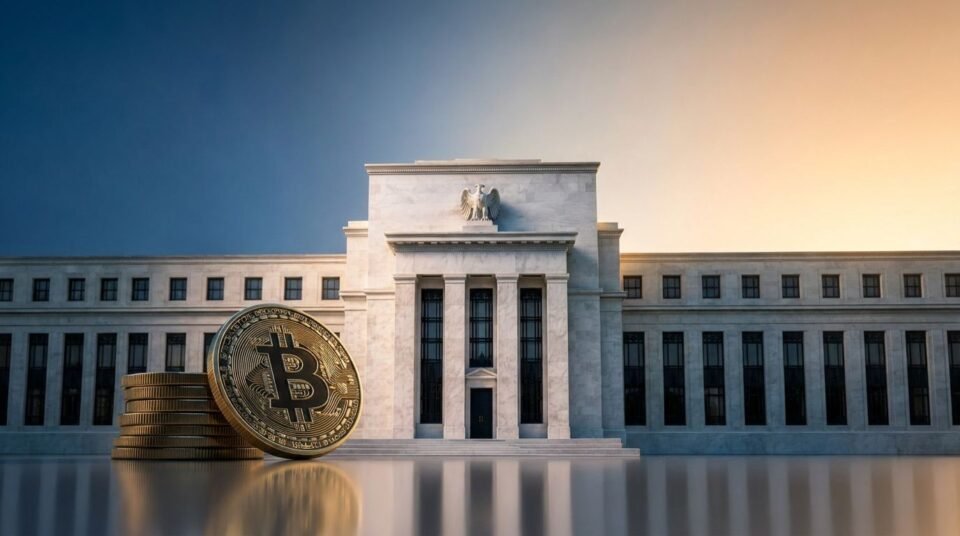
As the world holds its breath for a permanent ceasefire in the Gulf, Bitcoin has been holding up well, with Morgan Stanley’s new ETF apparently selling itself. A CME gap around $84K is tempting investors, who could be supercharged by a resolution around the Strait of Hormuz and a potential path back to some kind of normality.
Meanwhile, in Cryptoland, one of the standout projects of the last year has launched an upgrade that promises to take it to a whole new level of functionality. We break down the implications of Hyperliquid’s HIP-4 and what new toys users are going to have to play with. A classic case of bear market building that could set up big returns in the future.
🏦 Friends in High Places 🏦
Change is afoot at the Federal Reserve, with Kevin Warsh assuming the chair as Jerome Powell’s tenure comes to an end. Powell has promised to stick around, if only perhaps to act as a thorn in Trump’s side as the tug-of-war between hawks and doves continues. But it’s the new man at the top who’s getting the crypto community excited.
As revealed in his recent Senate confirmation hearing, Warsh is not only the wealthiest Fed Chair in living memory, but also a crypto holder. The thought of America’s chief economist stacking sats would have seemed fanciful not that long ago, but the world is changing fast.
In today’s video, we take a look at Warsh’s crypto credentials and look at whether he’s genuinely interested in the technology, or just using it to diversify his portfolio. We also examine the implications of the Fed chair holding digital assets and which crypto projects he’s invested in. And, given Warsh’s pronounced hawkishness when it comes to monetary policy, we ask whether the good news around him holding crypto is worth getting excited about.
You can watch that video here.
📈 Crypto Market Forecast 📈
Bitcoin pushed above $80,000 this week for the first time since late January, but the rally faces significant headwinds. The reclaim of $80K came with impressive ETF inflows: over $1.1 billion in net flows across four consecutive days. Yet traders remain cautious, hedging positions rather than chasing the breakout.
The macro backdrop remains complicated. Brent crude hovers around $102 per barrel, down from highs above $120 earlier in the conflict but still elevated enough to pressure consumers. Gold continues its run near $4,700 an ounce, reflecting persistent safe haven demand. The Iran situation took another turn this week when Bitcoin cleared $80K then reversed sharply on missile strike headlines. The pattern has become familiar: risk assets rally on ceasefire optimism, then give back gains when escalation resumes.
Suspicious oil trades placed before war headlines have now topped $7 billion, drawing regulatory scrutiny. Someone clearly knows what is coming before markets do. This creates an uneven playing field where macro headlines move faster than most traders can react. For Bitcoin specifically, the correlation to geopolitical news has been tighter than usual since February.
On the regulatory front, progress on US crypto legislation continues. The White House is now targeting a July 4 deadline to pass the landmark market structure bill. The CLARITY Act has seen encouraging momentum, with the crypto industry having backed the yield compromise, though traditional banking lobbies claim the proposal would enable regulatory evasion. The shift away from regulation by enforcement marks a genuine change in tone from Washington.
ETF flows tell an interesting story about who is buying. Self-directed investors continue powering inflows despite Morgan Stanley’s scale in the wealth management channel. The retail bid has proven more resilient than many expected, even as institutional allocators remain cautious about adding risk.
Ethereum continues to struggle for momentum. ETH remains range-bound until $2,400 is reclaimed, with spot demand weak and most price moves driven by perpetual markets. The narrative has shifted toward DeFi protocols going mainstream with AI agents, but so far this has not translated into sustained ETH price appreciation.
The AI narrative gained another institutional validation this week. Blackstone and Goldman are among the backers of a $1.5 billion Anthropic joint venture, signalling that traditional finance views AI infrastructure as a generational opportunity. The overlap between AI and crypto continues to strengthen, though crypto markets have yet to fully price in the implications.
Our directional call then: BTC likely fills the $84K CME gap within the next two weeks, but struggles to hold gains above $85K without a definitive resolution to Strait of Hormuz tensions. The setup favours bulls in the near term, with strong ETF flows and improving regulatory clarity. However, each geopolitical headline reminds us that risk assets remain at the mercy of developments in the Gulf. Until there is genuine de-escalation there, rallies should be treated as opportunities to take partial profits rather than add maximum leverage.
🔑 HIP-4: The Great Unlock 🔑
Last week, Hyperliquid’s HIP-4 upgrade went live on mainnet as a limited-feature initial release. This is a major and long-awaited upgrade that the market has been waiting for. In our honest assessment, a successful HIP-4 rollout is massive for the protocol in ways that many do not realise yet.
Before we dive into how, it’s important to establish some essential context for those unfamiliar with the upgrade.
As some of you may remember, HIP-4 introduces ‘outcome markets’ on Hyperliquid. These are fully collateralised contracts that settle within a fixed range. Each market consists of a Yes side and a No side; settlement converts one to a dollar and the other to zero, depending on the resolution. Prices float between 0.001 and 0.999 during continuous trading and represent the market’s implied probability of the underlying event. These contracts are useful for enabling prediction markets and bounded options-like instruments. There is no leverage, no funding rate, and no liquidation engine. The maximum loss is whatever was paid to enter, and positions are fully collateralised in USDH, Hyperliquid’s native stablecoin.
With that context established, let’s dive into the nitty-gritty.
The first market under HIP-4’s initial release features a recurring binary outcome that settles every morning at 06:00 UTC against the BTC mark price on HyperCore. The payoff structure is best understood via an example.
Take a “BTC above $80K by May 14″ market trading at $0.30. Buying YES costs 30 cents per contract for a possible $1 payout – if BTC settles above $80K on the resolution date, the trader pockets 70 cents per contract, and if it does not, the 30 cents is lost. Similarly, invert the trade for buying NO at $0.70. If you already use prediction market platforms like Polymarket or Kalshi, you’re familiar with this payoff structure.
This is probably why much of the media coverage on HIP-4 is focused around it being a prediction market upgrade for the protocol. In reality, prediction markets are but one use case that the upgrade unlocks. The real potential unleashed goes far beyond the widely parroted ‘prediction markets on Hyperliquid’ framing.
As X analyst Pink Brains notes in their extensive guide on the upgrade, “HIP-4 is the onchain options layer Hyperliquid could not build under HIP-3’s continuous-oracle constraints.”
The payoff structure in the BTC contract example we just gave is the same payoff structure as a call option, just expressed differently. While call options pay out based on how far above the strike the price finishes, a HIP-4 binary just pays a flat dollar regardless of how far above. So, a single binary is something like a flat-rate version of a call.
Ok, yes, that’s semantics but stay with us. You see, where Hyperliquid’s HIP-4 contracts set themselves apart from Polymarket/Kalshi contracts is at the protocol’s underlying portfolio margin layer. According to the Hyperliquid Guide, your outcome positions and your perp positions live in the same account and can automatically offset negatively correlated risks. If you’re long BTC perps and also hold a binary contract that pays out if BTC drops below a certain level, HyperCore recognises these as partially hedging positions. Your total margin requirement is lower than it would be holding each position in isolation. This creates real capital efficiency, although it’s only between positions that hedge each other.
While the current implementation of these contracts does not map 1:1 with traditional options, it sets the base for a future HIP upgrade to introduce them.
In the meantime, we see the bull case for HIP-4 resting on four things. None of them depend on Hyperliquid winning the retail prediction market war outright.
The first is the buyback flywheel. Roughly 97% of Hyperliquid’s protocol fees flow to the Assistance Fund, which executes HYPE buybacks. Fees generated from HIP-4 markets feed this buyback flywheel. HYPE holders directly benefit from platform usage in a way Polymarket and Kalshi users currently cannot.
The second is composability. Hyperliquid is the only crypto venue offering spot trading, perpetual futures, and prediction markets natively on a single execution layer with a unified margin system. This is a combination no centralised or decentralised competitor currently matches. Not to mention, HIP-4’s fee system is designed in a way that it maximises benefits for the platform’s most active users. For context, opening or minting an outcome position carries no fee. However, fees apply when closing, burning, or settling a position. As one user pointed out on launch day, a $100 entry on a comparable BTC market costs roughly $0.015 on Hyperliquid against $3.82 on Polymarket. This is a 250x cost gap before any settlement fees apply.
At first glance, this might seem predatory on users who carry contracts to settlement. But this is intentional. You see, volume on settled outcome markets count toward protocol-wide fee tiers. This means that active prediction market traders can qualify for lower rates on perpetuals through the same unified account. This cross-product fee discount is a powerful flywheel that Polymarket and Kalshi simply can’t replicate.
The third is the infrastructure gap on incumbent venues. For context, Polymarket runs off-chain order matching with on-chain settlement on Polygon. The platform has publicly disclosed that its traction has “massively outpaced” its current infrastructure and that fixing this is the “entire focus,” with a chain migration explicitly named as a priority. HIP-4, by contrast, launches directly onto Hyperliquid’s existing derivatives engine. This system already handles billions in open interest across perps, sharing the same matching engine and roughly 200,000 orders-per-second throughput.
The fourth and final reason for bullishness is the expansion path which we hinted at earlier. Unlike other binary outcome contract platforms, future upgrades can add functionality that builds new primitives on HIP-4. Besides enabling onchain options, Pink Brains points out that outcome contracts could function as insurance protocols. For instance, a shipping company buying YES on Strait of Hormuz disruption while running an offsetting oil perpetual in the same account.
It’s also worth noting that John Wang, Kalshi’s Head of Crypto, co-authored the HIP-4 proposal alongside Hyperliquid’s team and Framework Ventures. The two companies also announced a partnership in March to develop on-chain prediction markets. If that collaboration matures, it could either bring Kalshi’s regulated market design onto Hyperliquid’s L1 or seed an onchain spinoff of Kalshi sitting on the same infrastructure.
In sum then, HIP-4 unlocks so much for Hyperliquid as a whole. It’s also clear that the protocol doesn’t need to overtake Polymarket or Kalshi to win.
🔥 Hot Deal Of The Week 🔥
If you’re heading to Istanbul Blockchain Week this June, there’s a good chance you’ll see some familiar faces from the Coin Bureau team there. Taking place on the 2nd and 3rd of June in one of the world’s most dynamic cities, the event brings together leading voices across crypto, Web3, trading, infrastructure, AI, and digital finance for two days of panels, networking, and industry discussion. Whether you’re a builder, investor, trader, or simply crypto-curious, it’s shaping up to be one of the standout blockchain events of the summer.
We’d love to meet members of the Coin Bureau community in person while we’re there. If you’re planning to attend, you can use the exclusive coupon code COINBUREAU at checkout to receive 10% off your ticket purchase. It’s a great opportunity to connect with the wider crypto community, hear from major industry speakers, and meet the Coin Bureau team on the ground in Istanbul.
👉 Grab your tickets now, use code COINBUREAU for 10% off, and we’ll hopefully see you in Istanbul this June.
🏆 What’s New at CoinBureau.com This Week? 🏆
* Mantle Network Review 2026: Is It the Best Modular L2?
* Arbitrum Review 2026: Optimistic Rollup Pioneer or Losing Ground?
* Optimism (OP) Review 2026: The Superchain, OP Token & Everything You Need to Know
* Bitcoin vs Ethereum in 2026: BTC and ETH Compared
* Shibu Inu Coin Price Predictions (2026-2030): Why $1 Is Impossible for SHIB
* What Is Wrapped Bitcoin (WBTC) and How Does It Work? A 2026 Guide
* What Are Stablecoins? Types, How They Work, and Why They Matter In 2026
* How To Set Up A Crypto Trading Bot: Step-by-Step Guide For 2026
📖 Quote of the Week 📖
“You make most of your money in a bear market, you just don’t realize it at the time.” – Sir Shelby Cullom Davis
Team Coin Bureau
Disclosure: Authors may own cryptoassets named in this newsletter. These are unqualified opinions, and a Coin Bureau newsletter, is meant for informational purposes only. It is not meant to serve as investment advice. Please consult with your investment, tax, or legal advisor.