
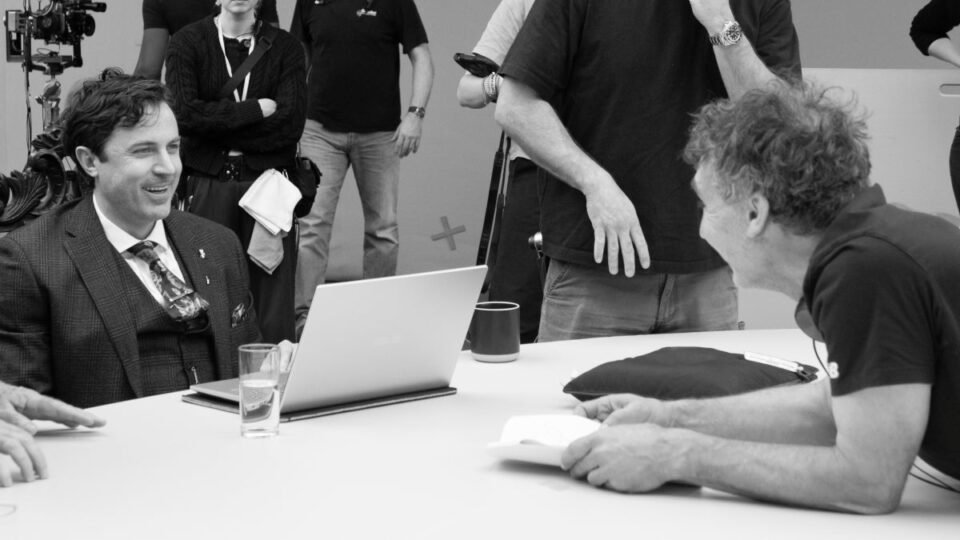
LONDON – A $70 million movie about the mysterious creator of Bitcoin quietly wrapped principal photography in London last month in a gray box that could have passed for a storage facility.
On the surface, it’s a pretty standard feature — Doug Liman directing a cast that includes Gal Gadot, Pete Davidson, Casey Affleck and Isla Fisher in a globe-trotting thriller about the search for the identity of the person who invented the decentralized cryptocurrency.
Except for one thing: “Bitcoin: Killing Satoshi” is described as the first fully-generated, studio-quality AI feature film.
Acme AI & FX — founded by Ryan and Matt Kavanaugh, Garrett Grant and Lawrence Grey — produced the independent feature, which was shot entirely on a custom-built soundstage over 20 days, using AI to make what would have traditionally cost $300 million on a much more manageable budget, according to the film’s producers.
TheWrap got exclusive access to the set of the movie — a large, drab room with a few props and basic set dressings, looking more like a stage for a one-act play than a film set. In place of finished backgrounds were giant walls with X’s on them, to be filled in by AI in post-production. Also missing: a traditional lighting system. Large overhead lamps brightly lit the entire set, but the usual trappings of a lighting department were nowhere to be seen. Again, the lighting will be filled in during post-production.
The AI-enhanced production comes as there’s been a greater embrace of AI across Hollywood as a matter of assistance instead of creation, as is the case with InterPositive, founded by Casey’s brother Ben Affleck, which was acquired by Netflix for $600 million and aims to offer AI-driven tools in post-production that streamline the moviemaking process.
Sora, OpenAI’s text-to-video app that was primed to team up with Disney, shuttered this year, and TheWrap reported that Runway ran into troubles at Lionsgate. AI in Hollywood, at least so far, has found more footing as a tool to assist the traditional production process rather than as a creative replacement.
It’s something that drew Liman, the boundary-pushing director behind “The Bourne Identity,” “Mr. & Mrs. Smith” and “Edge of Tomorrow,” to the project.
“We approached this film and this company with the ethical approach of making sure that every crew member is sustained and accounted for in the process,” Grant said. “It wasn’t left for a computer to interpret — we were the ones guiding it. And nothing beats the human being as far as creative ingenuity and craftsmanship. That’s how we built the company and this process with this film.”

He joined the film at the behest of producer Ryan Kavanaugh, who wanted to make a movie about the mystery surrounding the creator of Bitcoin, whose identity has been shrouded in secrecy, and the subject of many conspiracy theories. Kavanaugh tapped screenwriter Nick Shenk (“The Mule”) to write a draft three years ago before bringing it to Liman. In early 2025, producer Lawrence Grey (“Family Switch”) and executive producer Garrett Grant (“The Matrix Resurrections”) came onboard to establish both the studio and the production process.
“We decided to use AI very early on,” Kavanaugh told TheWrap during one of two visits to the set in March. “We budgeted out what it would be to do it practically and it was over $300 million. It has about 200 distinct locations, from Antarctica to Antigua to Vegas, which is obviously unproducible. We realized we could bring down the cost by utilizing some of the AI tools out there.”
The producer recruited people in the AI space to do some tests, after which they realized they “could produce it as 100% photo-realistic.” Not only that, but Kavanagh and co. could launch a company around it: Acme AI & FX. Liman’s AI company 30 Ninjas also worked on the film.

Nuts and bolts
To make “Bitcoin: Killing Satoshi” — which will be shopped to buyers at Cannes in May as it seeks distribution — the producers found a former car showroom in West London and converted it into a studio with offices and a sound stage they have termed the “gray box.” The room is completely wrapped in gray screen — blue and green tests produced subpar results — with consistent, neutral lighting.
There were traditional wardrobe and props departments, and the construction team built proxy set pieces like stairs and platforms. The film’s department heads include cinematographer Henry Braham (“Superman,” “Guardians of the Galaxy 3”), costume designer Richard Sale (“Jurassic World: Rebirth,” “Eternals”) and production designer Oliver Scholl (“Edge of Tomorrow,” “Spider-Man: Homecoming”).
Although the sets and lighting were generated with AI, the actors’ work will not be altered. They wore the costumes that will appear onscreen and Affleck had prosthetic work as part of his hair and makeup preparation. What the audience will see is the actual footage of the actors’ performances.

“The performances are the performances,” Kavanaugh said. “The performance is captured in a very unique way using our AI protocols. So when the scene is generated, the AI is taking the performance and building everything within the performance frame.”
While the producer declined to reveal the exact program the AI is running on, he said it’s “a new method” of inserting and combining the performance with all the backgrounds.
Affleck said the main draw for him was Liman, who has regularly embraced innovative techniques in his filmmaking. “Bitcoin is a disruptive technology and Doug got me really excited by the idea of using AI, which is another disruptive technology, to tell that story,” Affleck told TheWrap.
“He wanted the humor of ‘The Big Short’ and the energy of ‘The Wolf of Wall Street’ on steroids. He convinced me — he convinced everyone — that AI could help him realize that vision.”
The Oscar-winning actor called the process of acting in the film “incredible,” comparing it to doing a play.
“The entire focus on the set was on our performances. It was much more like acting in a Broadway play than in the giant event film that Doug’s final product will actually be. I feel like Doug reinvented spy movies with ‘The Bourne Identity,’ and I could see his mad genius at work trying to reinvent cinema itself. We were all standing around in awe.”

Scholl began designing the sets in October, and he and his team used a largely traditional process, including renderings, 3D models and hand drawings. Then they fed their reference images into the AI. Versions of the sets were generated virtually ahead of principal photography and Braham lit each scene using the AI program. Scholl, Liman’s frequent collaborator, saw it as “the same process” as a traditionally-shot film.
“AI is part of our process, but the process starts with human intent and human direction,” Scholl said. “Whether that’s modeling or reference searches. And then we get something back. The big difference is that you go on ChatGPT and ask for a generation of an image, you just put a text prompt in and you accept what you get. In this case, what goes in the prompt is already an image that’s previously generated by us. It’s much more specific.”

That process is similar to the one used by InterPositive. While it has a core model built from proprietary footage shot by the startup, each project can further customize the model — and its output — by feeding it raw dailies from the film’s shoot. In both cases, the source material that AI is working with is original footage shot by the filmmakers.
The human component
In total, producers said “Killing Satoshi” employed 107 cast members, 100 shoot crew and 54 non-shoot crew — fairly on par for an independent feature, although major blockbusters can employ thousands of crew members to bring them to fruition.
Liman is now in the midst of 30 weeks of post-production, which will involve 55 AI artists. Grey explained that “AI doesn’t replace the human component,” adding that “the human component is desperately needed in the process.”
AI remains a touchy subject for large swaths of the entertainment industry, with some writing off the technology as completely devoid of human creativity, and others fearing that their livelihoods will be replaced by lines of code.
But while many have publicly slammed AI, there are some quietly looking at the opportunities created by the technology, with a growing number of creatives finding ways to utilize it responsibly.
“Generally, the community was apprehensive,” Grey said of the reaction to their decision to make the film using AI. “Everyone projects their insecurities and fears into AI: It’s going to steal jobs in Hollywood. It’s going to kill the business. But what we started noticing as we were making outreach to the community is that people were saying one thing publicly, but underneath everyone was understanding that, yeah, this is inevitable. It’s here. And it actually can help. It’s actually a tool to democratize filmmaking, and so there was a real openness and warmth as long as they knew we were doing it in the right way.”

The production approach means there is less travel, less turnaround time between scenes and less physical waste, the producers said. Sets weren’t built and discarded, and the cast was only required to be present for three weeks of shooting. Some jobs, like those in the lighting department, weren’t relevant to the process. But others, like the AI artists, have been created.
The story
“Bitcoin: Killing Satoshi” is described, per the official synopsis exclusively shared with TheWrap, as a “a high-stakes conspiracy thriller that asks the question no one in power wants answered: Why have the world’s most powerful and wealthiest people — Jack Dorsey, Mark Zuckerberg, Visa and virtually every major crypto organization — poured hundreds of millions of dollars into a single mega-organization called COPA, with one sole purpose: to destroy one man?”
It centers on the mysterious identity of Satoshi Nakamoto, the infamous pseudonym of the Bitcoin creator. Gadot plays a seasoned war correspondent and former fashion model named Lotte who is recruited by Calvin Ayre (Davidson), a crypto and gambling mogul, to write an investigative report about Dr. Craig Wright (Affleck), who is said to be the elusive Satoshi and who has survived myriad assassination attempts as a result.
The official synopsis notes, “All this leads Lotte, and the audience, to the central question — If Craig Wright didn’t invent Bitcoin, why is a coalition controlling trillions in global wealth spending hundreds of millions and risking everything to destroy him?”
While the assertion that Wright is Satoshi has been debunked by some, including a U.K. court, there’s still a great deal of mystery and interest surrounding the Bitcoin creator’s true identity. A documentary about the topic, “Finding Satoshi,” debuts next week.
Acme AI & FX is based in Los Angeles and London, with a third studio being built in New York and additional locations planned for Vancouver and Spain. There are 10 future projects in the company’s pipeline.
“For us, it’s really about: How can we make the economics of filmmaking more democratized so we can be making more films for an industry?” Grey said. “How can we be empowering talent to be able to achieve their vision with greater focus and greater resources? At the end of the day, it’s still about making great films, and that’s what we think this allows us to do.”
