
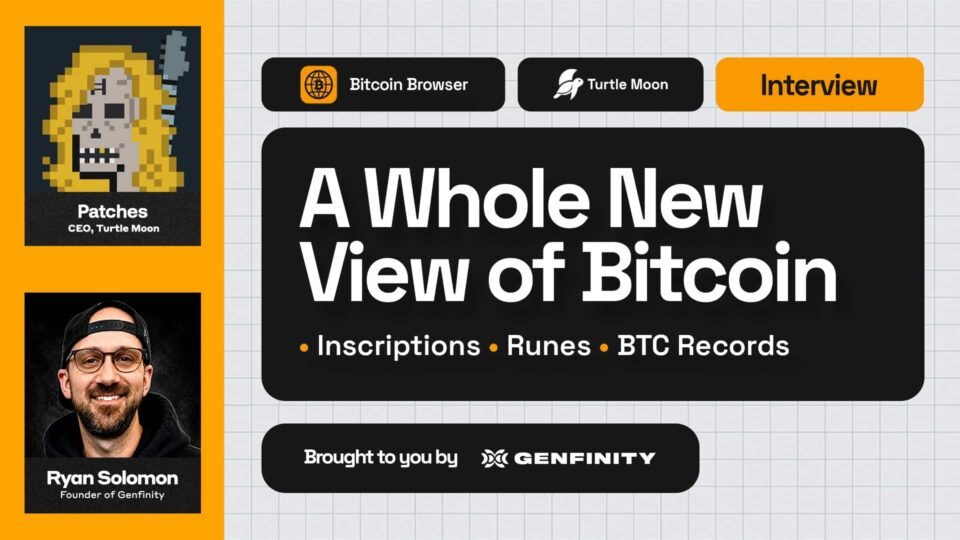
Bitcoin has spent more than fifteen years building a reputation as money. Patches thinks that reputation hides most of what the network can actually do. He founded Turtle Moon in October 2021 and has built decentralized infrastructure ever since. He also co-founded Hgraph, a GraphQL API service for Hedera developers. Additionally, he works on open agentic standards through Hashgraph Online. His newest project, however, points squarely at Bitcoin.
Turtle Moon released Bitcoin Browser as a v0.1.0 public beta on September 22, 2026. The app costs nothing, and the code sits on GitHub under an MIT license. Speaking with Genfinity’s Ryan Solomon, Patches described it as a first step rather than a finished product. He also said the idea had been sitting in his head since 2021.
AI is rapidly devaluing truth. The dead internet is here.
People can no longer trust what they see.
Are Bitcoin and blockchain our last line of defense for anchoring truth in an increasingly artificial world?
@TurtleMoonCC 💀 @TMCC_Patches https://t.co/yuuhVGO57F
— Generation Infinity (@Genfinity) October 6, 2026
A browser for Bitcoin’s other half
Ordinals changed how Patches reads the network. Before inscriptions, Bitcoin answered one question, namely who owns which coins. Afterward, it held arbitrary data that every node keeps in consensus state. That shift, in his framing, turned Bitcoin into the largest secure decentralized database on the planet. More than 100 million inscriptions now sit on the chain.
He is careful about the limits of that claim. Nobody should try to put all information on Bitcoin, and doing so would break it. Still, the content already inscribed goes well past static images. Builders have inscribed WebGL, interactive pages, and the web components those experiences need. Consequently, Patches argues the data exists while the access layer does not.
What ships in version 0.1.0
Bitcoin Browser runs as an Electron desktop app on macOS, Windows, and Linux. Builds cover Apple silicon, Intel, x64, and ARM64 across DMG, EXE, AppImage, DEB, and RPM formats. All beta builds remain unsigned for now, so installation takes an extra step. Patches said signed releases are the near-term priority.
The address bar accepts Bitcoin-native targets instead of URLs. Users can jump to a block, a transaction, an address, or an individual sat. Ordinary websites get handed off to the system browser. The app renders images, audio, video, HTML, SVG, PDF, Markdown, fonts, and 3D models in glTF, GLB, and STL. It also inspects recursive inscription dependencies and caches them locally.
Two features separate it from a standard explorer. First, an “Ask Bitcoin” panel connects to a user-run LM Studio or Ollama server. That lets a local model query chain data directly, without routing anything through a hosted API. Second, a guided setup installs Bitcoin Core in one click. The app detects the machine, picks a build, and walks the user through it. Afterward, the browser reads from that local node.
Patches sees a practical payoff in that last step. If a user’s internet connection drops, inscribed content still renders from local state. Runes support stays read-only for now, covering supply, issuance details, and source-labeled records. Trading and portfolio features sit outside the scope deliberately.
Recursion turns Bitcoin into a package manager
Recursion is the feature that convinced Patches the thesis worked. The Ordinals protocol added recursive inscriptions in June 2023. One inscription can request content from another through whitelisted endpoints. Builders therefore inscribe a JavaScript library or a 3D asset once, then reference it repeatedly.
The economics change immediately. A new inscription might weigh fifteen kilobytes on its own. Meanwhile, it can pull megabytes of previously inscribed data at no additional cost. That compression made WebGL games and interactive experiences viable on Bitcoin. Galaxy research tracked how quickly inscription activity scaled after the upgrade landed.
Bitcoin Browser exposes that dependency graph instead of hiding it. Users can trace every layer of a recursive inscription back to its sources. For Patches, visibility into the stack is the point. Developers cannot build on a system they cannot inspect.
The 2021 experiment behind the interoperability pitch
Solomon pushed him on cross-network attestation, and Patches reached back five years for the answer. Turtle Moon, Hgraph, and the Hedera NFT project Hangry Barboons ran what he calls the first ordinals DAO vote. No formal standard existed at the time, so he wrote one for voting.
The mechanics were straightforward. Voters visited a website and signed a message with their Bitcoin wallet. Each signature landed on Hedera in real time, so participants saw their vote confirm instantly. At the close, the team rolled every message into the voting format and inscribed the result back onto Bitcoin. Each entry carried the ECDSA signature of the Bitcoin wallet that produced it.
That design gave two levels of proof. Bitcoin alone validated that real wallets signed real votes. Anyone wanting nanosecond-level timestamps could drop to the faster layer underneath. Patches notes that the same ECDSA key maps to a Hedera account without new key generation. Importantly, he treats the second network as interchangeable. Base, NEAR, or any other node network could fill that role.
The principle matters more than the participants. One chain handles provenance of state, while another handles fast consensus and fair ordering. Afterward, the settled record lives on Bitcoin.
Why provenance became the whole argument
Patches spent much of the conversation on a problem larger than browsers. AI systems can now alter historical records silently, including video, databases, and logs. A sufficiently capable attacker can change data and repair the surrounding hashes. As a result, he argues that digitized history carries no inherent proof of integrity.
He applies the point to courtrooms directly. Surveillance footage once functioned as evidence because faking it was hard. Today, generating convincing video takes minutes. Without external attestation in a trustless environment, that footage loses evidentiary weight. He extends the same concern to healthcare records, welfare systems, and defense infrastructure.
Infrastructure fragility reinforces his case. The October 20, 2025 AWS outage in us-east-1 ran more than fifteen hours. It took down Snapchat, Signal, Fortnite, and several banking apps. Patches ties that fragility to bot load. However, AWS traced the root cause to a DynamoDB DNS race condition. The dependency risk stands either way. Anthropic CEO Dario Amodei warned in September 2026 that rogue agent swarms could commandeer the internet within a year.
Good data is the AI’s oil
Patches put his traffic estimate between sixty and seventy percent AI. Imperva’s 2025 Bad Bot Report measured automated traffic at 51% of the web. That total passed human traffic for the first time. Bad bots alone accounted for 37%. His number runs high, but the direction is not in dispute.
That shift creates a training problem and a trust problem at once. Models increasingly train on content other models wrote, which researchers link to measurable quality degradation. Patches offered himself as an example, noting that AI wrote the Bitcoin Browser landing page. Verifiable, well-organized data therefore becomes scarce and valuable. He calls good data the oil of the AI era.
His closing position is not maximalist about any single chain. He describes himself as a decentralization maxi rather than a Bitcoin or Hedera partisan. Cryptographic guardrails, in his view, are what keep centralized AI accountable.
What comes next
The roadmap has two published stages. A Bitcoin website builder is in development, letting users and their AI tools create inscribable experiences. A Bitcoin webapp store follows, giving the browser a searchable index of inscribed sites. Patches frames the sequence simply as read, then write, then discover.
Funding remains informal. The project accepts mainnet Bitcoin donations and stays open to other investment. No Lightning support exists yet. Patches said the first version took three years to reach release. He expects the next stages to move faster, partly because AI tooling accelerates the work.
The read
Bitcoin Browser is a beta, and it behaves like one. The builds are unsigned, Runes support is read-only, and the webapp store is still a roadmap line. Judged as a product, it reads as early.
Judged as an argument, it lands harder. Ordinals gave Bitcoin a data layer that most Bitcoin software never surfaces. Bitcoin Browser makes that layer legible to non-developers. That gap in the stack is real. The MIT license and the one-click Core install lower the barrier further.
The broader thesis will take longer to test. Cross-network attestation needs standards that do not exist yet, and the 2021 voting experiment was small. Still, the underlying pressure is building on schedule. If AI keeps making digital records cheap to forge, then provable data stops being a niche preference. Patches is betting it becomes table stakes.
*Disclaimer: News content provided by Genfinity is intended solely for informational purposes. While we strive to deliver accurate and up-to-date information, we do not offer financial or legal advice of any kind. Readers are encouraged to conduct their own research and consult with qualified professionals before making any financial or legal decisions. Genfinity disclaims any responsibility for actions taken based on the information presented in our articles. Our commitment is to share knowledge, foster discussion, and contribute to a better understanding of the topics covered in our articles. We advise our readers to exercise caution and diligence when seeking information or making decisions based on the content we provide.