
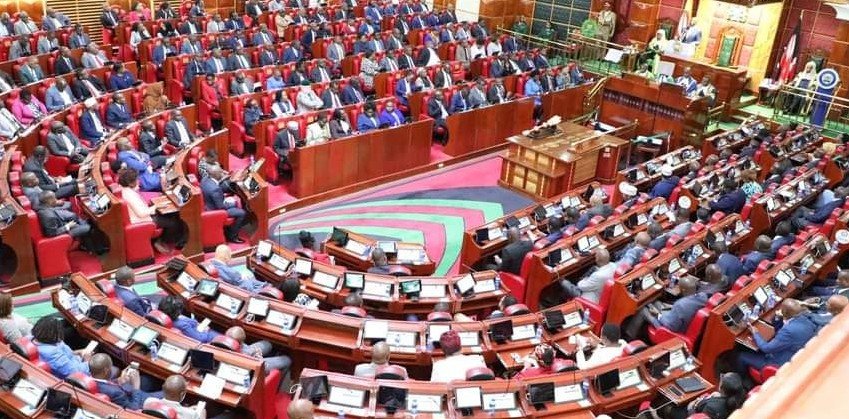
Kenyans have until Monday, May 25, 2026, to submit their views on the Finance Bill, 2026, as Parliament opens up the proposed tax law for public participation before it is debated in the National Assembly.
The Bill seeks to overhaul several tax laws, introducing wide-ranging changes touching on income tax, VAT, excise duty and tax administration in a bid to streamline compliance and close legal loopholes.
The memoranda on the Finance Bill, National Assembly Bill No. 26 of 2026, have already been referred to the Departmental Committee on Finance and National Planning for scrutiny and reporting back to the House.
The notice, issued in line with Article 118(1)(b) of the Constitution and Standing Order 127(3), highlights Parliament’s obligation to facilitate public participation in legislative processes and committee work.
The Finance Bill, 2026, sponsored by Molo MP Kuria Kimani, proposes amendments to multiple tax-related laws, including the Income Tax Act, Cap. 470; Value Added Tax Act, Cap. 476; Excise Duty Act, Cap. 472; Tax Procedures Act, Cap. 469B; Miscellaneous Fees and Levies Act, Cap. 469C; Stamp Duty Act, Cap. 480 and the Road Maintenance Levy Act, Cap. 427.
According to Parliament, the Bill is largely aimed at easing tax administration, improving clarity in the law, and removing outdated provisions and cross-references to repealed sections.
Under the Income Tax Act, the Bill proposes a new definition of “royalty” to include payments for the right to use proprietary digital platforms, payment networks, card schemes, payment processing, switching, clearing or settlement systems, as well as access or participation rights through a card.
The proposal further states that such payments will be treated as royalties regardless of whether they are periodic or transaction-based, and irrespective of how they are described, including service, transaction, network, assessment or processing fees.
The Bill also introduces definitions for “withdrawals” and “winnings” in relation to gambling activities under the Gambling Control Act, and clarifies that gratuity paid under a contract of service lasting at least three years shall not be considered a gain or profit.
On taxation of property income, the Bill states that Non-Resident Rental Income Tax will apply at 30 per cent on income earned by non-residents from the use or occupation of property located in Kenya, and that this will be a final tax.
Non-resident ship owners, charterers, and air transport operators will also be required to remit income tax within five days of earning income from ships or aircraft they own or charter.
The Bill further proposes that payments made to residents from the sale of scrap metal and gambling winnings will be treated as taxable income, with scrap metal taxed at 1.5 per cent and winnings at 20 per cent.
On trust income, the Bill seeks to repeal and replace existing provisions to provide that income received by a trustee, executor or administrator shall be deemed to be their income for taxation purposes. It also provides that any dividend or interest included in trust income shall not be taxed again, and beneficiaries shall not be liable where tax has already been paid by the trustee, executor or administrator.
“Taxpayers who, in their own judgement, expect to have no taxable income for the year apart from emoluments will not be required to pay instalment tax,” reads the Bill.
The Bill also proposes to repeal provisions on transactions designed to avoid tax liability, which will instead be re-enacted under the Tax Procedures Act for administrative clarity.
In addition, the Commissioner will be empowered to direct that at least 60 per cent of a company’s income be treated as distributed dividends for taxation purposes.
Tax filing timelines are also proposed to change, with returns required to be filed on or before the last day of the fourth month after the end of the income year, down from the current six-month period.
The Bill further proposes exemptions from income tax on death-related benefits and capital gains arising from the transfer of property to a real estate investment trust.
In addition, repatriated income earned by mining contractors and licensees will be taxed at 15 per cent, while the corporate tax rate for non-resident persons is proposed to be reduced from 37.5 per cent to 30 per cent.
VAT Act amendments
The Bill proposes that hire purchase arrangements entered into by licensed providers under registered agreements will not be treated as taxable supplies, with financial charges under such agreements exempted.
It also provides that, “the period for claiming VAT refunds on bad debts will be extended from two years to three years.”
Several goods and services are also proposed to be exempted from VAT, including dialysers, scrap metal, and goods used exclusively for infrastructure projects under public-private partnerships, subject to approval by the Cabinet Secretary for Finance.
The Bill further reclassifies several goods from zero-rated to exempt status, including raw materials for animal feeds, sugarcane transport services, telephones for cellular and wireless networks, motorcycles under tariff heading 8711.60.00, electric bicycles, solar and lithium-ion batteries, electric buses, Bioethano Vapour stoves under HS Code 7321.12.00, and worn clothing except at importation.
Excise Duty changes
Under the Excise Duty Act, the Bill provides that excise duty on telephones for cellular and wireless networks will become payable at the point of activation.
It also introduces new excise rates, including 25 per cent on telephones for cellular networks, 10 per cent on selected plastic products under tariff headings 3923.30.00 and 3923.90.90, 5 per cent on coal, and 50 per cent on antiques, vintage and classic vehicles.
Excise duty on cigars, cheroots and cigarillos is proposed to increase from Sh16,260.29 per kilogramme to Sh18,000 per kilogramme, while other tobacco products will rise from Sh11,382.48 per kilogramme to Sh12,550 per kilogramme.
The Road Maintenance Levy Act is also proposed to be amended to reduce the amount allocated to the road annuity fund from Sh3 to Sh1.50.
National Assembly Clerk Samuek Njoroge said written memoranda must include the name and contact details of the individual or organisation submitting the views.