
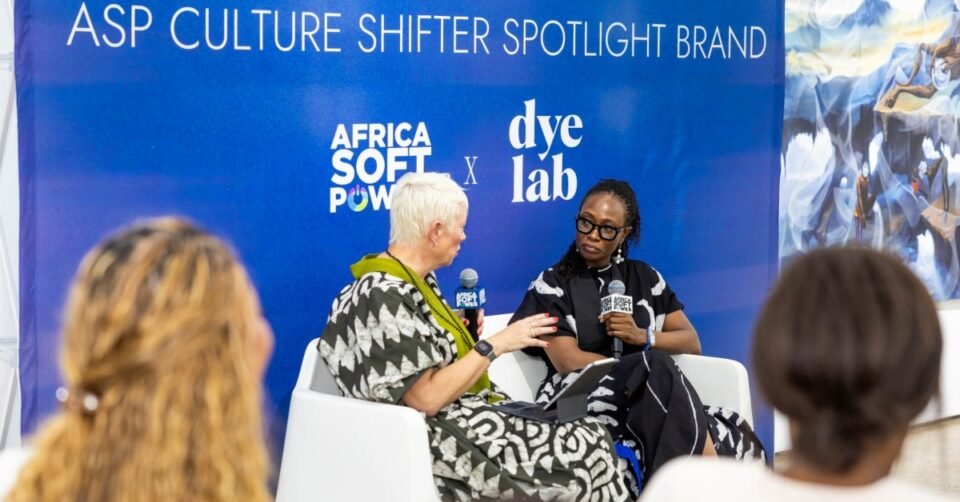
When Rukky Ladoja told an audience in Nairobi that Dye Lab was raising capital to build a dyeing and production facility in Ibadan, she was not simply announcing the next phase of a fashion brand. She was pointing to one of the harder constraints behind African fashion’s recent rise: demand is growing faster than the systems built to support it.
Five years into building one of Africa’s most recognisable contemporary fashion brands, Ladoja has reached a conclusion many creative founders eventually confront. The problem is not always the market. Often, it is the machinery around the market: production, training, consistency, quality control, and the ability to move from admired product to scalable enterprise.
Speaking at the Africa Soft Power Summit in Nairobi, first on a panel examining the female economy on May 21st, and later in a fireside conversation hosted as part of the Summit’s Culture Shifter Spotlight on May 22nd, Ladoja outlined plans for a Dye Lab-anchored facility in Ibadan. The proposed hub is being designed as shared infrastructure: a dyeing, manufacturing and training centre that would support Dye Lab’s own growth, while also serving other fashion businesses that face similar production bottlenecks.
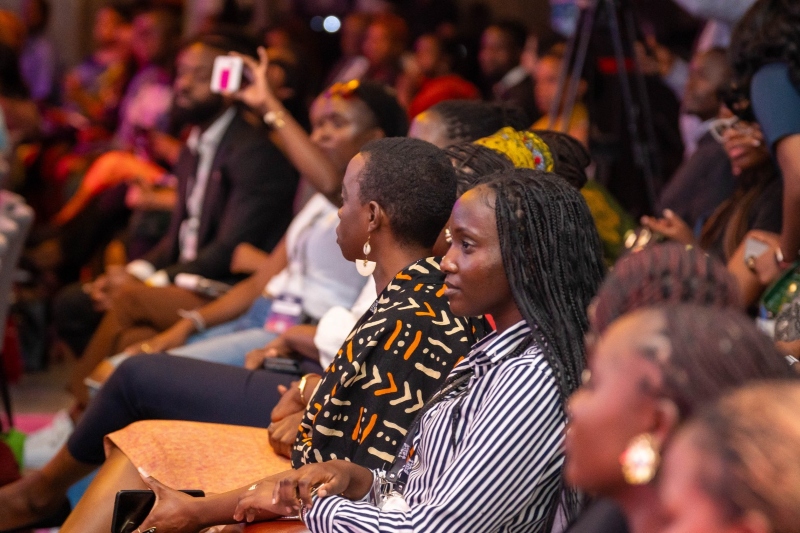
The case for that expansion rests on more than ambition. Dye Lab has already taken its work through pop-ups in 15 cities, 11 countries and four continents, building an international following while remaining anchored in Lagos. The gap Ladoja is now trying to close is not demand, but the manufacturing capacity needed to meet it.
For Dye Lab, the move comes after years of working around the limits of a fragmented manufacturing base. The brand currently relies on a decentralised model, working with more than ten factories across Nigeria, with different facilities producing different components. “We are working with over 10 factories,” Ladoja said. “A decentralised model where one factory produces one thing. But we are still getting a lot of issues. It is time to bring this in house. It is time to train more tailors.”
That comment goes to the centre of the proposition. African fashion has never lacked imagination, craftsmanship or consumer appeal. What it has lacked, at least at scale, is the industrial depth to match the attention it now receives. Brands that generate demand often find themselves trying to stitch together suppliers, artisans, tailors and quality-control processes across informal or semi-formal systems. The result is familiar: long lead times, inconsistent finishing, limited technical specialisation and a ceiling on how far even a strong brand can grow.
Dye Lab’s response is to build capacity closer to the source. The choice of Ibadan is personal, but also strategic. Ladoja, who is from the city, described a gap in the local manufacturing and technical skills base. “In Nigeria, in Ibadan where I am from, there are not a lot of technicians,” she said. “We want to create a hub where we are able to build specialisation across the entire value chain, and hopefully that inspires a wave of training across the country.”
The ambition is not only to produce more garments. It is to formalise knowledge that has often lived informally: dyeing techniques, textile handling, production planning, tailoring, waste management, finishing, and the operational discipline required to deliver at scale. Ladoja has described Dye Lab’s first five years as a kind of internal case study: how much the brand can sell, how many customers return, how many women it can support, and how that work changes the lives of people across its value chain.
That emphasis matters because Dye Lab’s growth story complicates one of the assumptions often made about African fashion: that scale depends primarily on export. Ladoja was clear that Dye Lab’s demand is already strong within the continent. “Our demand continues to outstrip our supply. We’re not able to keep up, which is amazing,” she said. “This is what we all pray for. It proves that there is a market for us within the continent. We always think we have to go outside for revenue, but it’s within here that we do most of our sales.”
In other words, the Ibadan hub is not an attempt to manufacture legitimacy for foreign markets. It is an attempt to close the gap between what the market wants and what the brand can currently deliver, while building the kind of production base that could eventually support both continental and global work. That distinction is important. African fashion is often celebrated internationally through runway moments, celebrity placement and cultural visibility. Dye Lab’s announcement was about something less glamorous but arguably more consequential: the factory floor.
The Africa Soft Power Summit provided a useful setting for that shift in emphasis. This year’s theme, “Africa’s Compound Interest: Aligning Ecosystems of Finance, Creativity and Human Capital for Growth,” asked what happens when African cultural influence is matched with the capital, skills and institutions required to turn attention into enduring value.
That is also where the Summit’s own positioning becomes clearer. Increasingly, its significance may lie less in simply convening creative and business leaders, and more in creating the kind of room where African organisations can make growth-stage arguments in front of people who understand the difference between profile and scale. “For us, the question has always been what happens after visibility,” said Nkiru Balonwu, founder of Africa Soft Power. “How do African companies move from attention to infrastructure, from cultural relevance to capital, and from individual success to wider ecosystem value?” Dye Lab’s announcement offered one answer: a brand using cultural traction to make a case for production capacity, technical training and shared industrial infrastructure.
The commercial case is straightforward, even if the execution will not be. Dye Lab has a market. It has a product. It has proof of demand. What it needs now is the production capacity to match that demand without losing the craft, cultural familiarity and accessibility that made the brand work in the first place. Ladoja put the question simply elsewhere in the discussion: “How do you create locally, in a way that’s familiar but can still be exportable?”
The next challenge is whether the systems around the product can mature at the same pace as the demand for it. For Ladoja, that means moving beyond commerce into capability-building. “We have a market. We have a product. We’re expanding,” she said. “So why don’t we do it ourselves, and create an innovation centre where people can come, train, understand how to do this better, and grow slowly while taking your community along.”
There is also an environmental dimension to the planned facility. Dyeing is water-intensive, and the waste it produces is increasingly difficult to ignore in any serious conversation about responsible manufacturing. Ladoja did not frame this as an afterthought. “There is now a responsibility to contribute something more than just commerce – environmentally, operationally,” she said. “How do we dispose of our waste water better? How do we produce better? I want to solve for that.”
For investors, that could become part of the facility’s appeal. A production hub built with waste management, training and process efficiency in mind is not only a social-good story. It is a stronger business proposition in a sector where quality, traceability and responsible production are becoming harder to separate from growth.
Ladoja’s longer-term ambition is for Dye Lab to become more than a fashion label. “The potential people see in fashion is still very low and very limited,” she said. “We want to be one of the brands that is able to consult and produce for other fashion brands, not just within the continent, but outside as well.”
That is the more significant play. If the Ibadan facility succeeds, Dye Lab would not simply have solved its own supply problem. It would have created a piece of industrial infrastructure that other brands could use, learn from, and build around. In a sector often described through aesthetics and influence, Ladoja is making a more grounded argument: African fashion will only capture more value when it owns more of the systems that make fashion possible.
The announcement in Nairobi was therefore not only about a factory. It was about what African creative businesses need after the world has noticed them. Attention can open doors, but it does not cut fabric, train technicians, standardise production or manage wastewater. Those things require capital, patience and infrastructure. Dye Lab has already proved that there is demand for a modern African brand built from local identity. Its next test is whether that demand can be converted into capacity.