
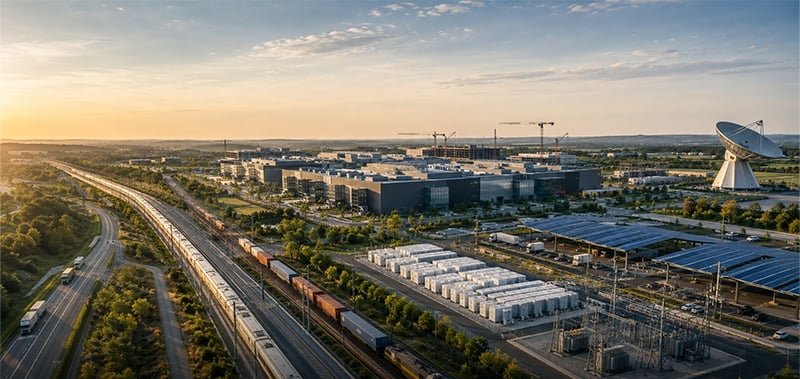
The next major wave of economic growth will not be driven by a single breakthrough technology. It will be built on the foundational systems that allow new technologies, services, and business models to scale.
I see three areas becoming increasingly important: space infrastructure, data infrastructure, and quantum infrastructure. Each is developing differently, but all three are creating platforms that can support entirely new forms of economic activity.
For leaders, the opportunity is not simply to predict which product will become popular next. It is to identify the Hard Trends shaping the systems underneath those products. When you develop an Anticipatory Mindset and a stronger Futureview®, you can see where long-term momentum is building and prepare before the opportunities become obvious.
Why Should You Follow Infrastructure Instead of Chasing the Latest Technology?

When most people think about innovation, they focus on what they can see. They notice a new AI application, an advanced satellite, a powerful computer, or an emerging digital service.
I encourage everyone to look deeper at those innovations.
Infrastructure determines which innovations can scale, how quickly they can spread, and which new markets can develop around them.
History provides plenty of evidence. Railroads did more than move trains. They accelerated commerce and industrial expansion. Highways did more than connect cities. They transformed logistics, retail, housing, and consumer behavior. The internet did more than connect computers. It created the foundation for today’s digital economy.
This pattern is continuing. Recent McKinsey research estimates that approximately $106 trillion in cumulative infrastructure investment will be needed globally by 2040 as digital, energy, transportation, and social infrastructure evolve together.
That is why infrastructure deserves more attention in strategic planning. When enormous amounts of capital, talent, government support, and private investment move toward foundational capabilities, leaders should pay attention. It can be an important signal of what comes next.
Which Three Infrastructure Trends Could Create the Greatest Opportunities?

There are many infrastructure developments worth monitoring. However, three stand out to me because they are already attracting investment, long-term planning, and public-private collaboration.
The three areas I am watching closely are:
- Space infrastructure: Satellite constellations, orbital services, lunar systems, and commercial space facilities.
- Data infrastructure: Data centers, cloud platforms, fiber networks, subsea cables, and advanced computing capacity.
- Quantum infrastructure: Quantum computing resources, specialized hardware, research networks, and quantum communications.
These are not three versions of the same trend. Each has different timelines, challenges, and applications.
Together, however, they will influence how information moves, where computing takes place, how organizations collaborate, and how rapidly new innovations can reach scale.
How Is Space Infrastructure Becoming Part of the Everyday Economy?

For decades, many people viewed space primarily through the lens of exploration.
That viewpoint has to change.
Space is rapidly becoming an operational environment. Satellite constellations, commercial space stations, in-orbit services, and lunar programs are creating capabilities that extend far beyond traditional government-led exploration.
Example 1: Global connectivity. Starlink, operated by SpaceX, has deployed thousands of low Earth orbit satellites designed to provide broadband connectivity across much of the world.
The implications go beyond faster internet access. Satellite connectivity can improve communications in remote regions, provide redundancy when terrestrial infrastructure is damaged, and support emergency response.
Example 2: Sustained lunar activity. NASA’s Artemis program has brought renewed attention to lunar exploration. More importantly from an infrastructure perspective, it represents part of a broader effort to develop capabilities that can support sustained activity beyond Earth.
Example 3: Commercial facilities in orbit. Companies including Axiom Space are developing privately operated space stations. Those facilities could eventually support research, manufacturing, and other commercial activities.
The larger shift is what matters.
Space infrastructure is moving from something used primarily by governments toward a platform that can support growing commercial activity.
When infrastructure becomes accessible to more organizations, innovation can accelerate around it. Leaders should therefore ask what improved satellite connectivity, orbital capabilities, and commercial space services could eventually make possible in their own industries.
Why Will Data Infrastructure Become Even More Valuable as AI Expands?

Artificial intelligence receives enormous attention, but AI does not exist independently of infrastructure.
Every AI model depends on computing power. Digital services depend on networks. Connected devices continuously generate and exchange information. Cloud services require physical facilities capable of storing and processing enormous quantities of data.
That makes data infrastructure increasingly strategic.
Cloud platforms, fiber networks, data centers, and subsea cables rarely generate the excitement associated with the latest AI application. Yet they make those applications possible.
Consider these three examples:
Example 1: Google and global connectivity. Google has invested in a global network of subsea cables that strengthens the physical infrastructure supporting international digital communications.
Example 2: Equinix and interconnected computing. Equinix operates interconnected data centers where enterprises, networks, and cloud providers can exchange information with low latency.
Example 3: Microsoft and NVIDIA and AI computing. Both companies continue investing in the computing infrastructure required to support growing demand for artificial intelligence.
These developments demonstrate why leaders should not think about data infrastructure as merely a background utility. As digital activity increases, dependable access to computing, storage, and connectivity becomes a competitive capability.
The scale of the opportunity is significant. McKinsey projects that global data-center demand could nearly triple by 2030, driven largely by AI workloads. Cumulative investment in data-center infrastructure is expected to exceed $1.7 trillion through the end of the decade.
Those numbers point to something bigger than a temporary surge in interest. Organizations are building the physical and digital foundation needed for much greater computing demand.
Why Should Leaders Watch Quantum Infrastructure Before Quantum Computing Fully Matures?

Quantum computing is at a very different stage of development than conventional data infrastructure. Leaders should not assume every emerging quantum application is inevitable.
However, what they should pay attention to is the infrastructure being constructed around the technology.
Infrastructure can begin developing well before a technology reaches widespread commercial adoption.
IBM’s Quantum Network, for example, connects businesses, universities, and research organizations with quantum computing resources. This gives participants opportunities to experiment, develop skills, and investigate potential applications.
Companies such as PsiQuantum are working with semiconductor manufacturers on photonic quantum chips. Quantinuum continues advancing quantum hardware and software. At the same time, government agencies including the U.S. Department of Energy are investing in quantum networking research.
These activities matter because infrastructure can reduce barriers to future adoption. When computing resources, research partnerships, manufacturing capabilities, networks, and skilled workforces already exist, practical applications have a stronger foundation from which to expand.
Quantum progress will take time. The exact winners and applications remain uncertain. That is precisely why leaders should separate what they know from what they merely assume.
My Hard Trend Methodology is built around this concept. A Hard Trend is based on future facts that will happen, while a Soft Trend represents something that might happen and is therefore open to influence.
We do not have to pretend that every detail of the quantum future is predictable. The goal is actually in identifying enough certainty to make better decisions about where to watch, learn, experiment, and prepare.
How Can a Shared Futureview® Help Your Organization See These Opportunities Earlier?

Seeing a trend is valuable, but aligning an organization around what that trend means is even more important.
This is where Futureview® becomes critical.
Every organization has a view of the future, whether leaders consciously develop it or not. The question is whether that view is reactive, fragmented, and dominated by uncertainty, or whether it is informed by visible Hard Trends.
I’ve long emphasized that there is more certainty about the future than most people realize. The key is knowing where to look. When leaders focus only on what they cannot predict, they can limit their ability to take meaningful action.
An aligned Futureview® helps teams focus on what they can know.
When investment repeatedly flows into foundational infrastructure, for example, it can provide a useful indication that larger markets and capabilities are developing around it.
Of course, that does not completely eliminate uncertainty, nor does it mean leaders should automatically invest in every technology associated with a growing infrastructure trend.
Instead, it gives them a stronger starting point for asking better questions.
The more clearly your organization understands what is coming, the earlier you can identify what those developments mean for your customers, partners, operations, and competitive position.
That is how you move from reacting to change toward becoming Anticipatory.
What Questions Should Leaders Ask About Emerging Infrastructure Right Now?

You don’t need to launch satellites, construct a data center, or build a quantum computer to benefit from these trends.
What you do need is elevated awareness about infrastructure.
Infrastructure can alter the capabilities available to your customers and competitors. It can create new partnership opportunities. It can change supply chains and enable business models that previously would have been impractical.
I recommend starting with four questions:
- Which infrastructure investments could reshape your industry? Look beyond direct competitors and examine where governments, technology companies, investors, and research organizations are building long-term capabilities.
- How could better connectivity create new value? Consider what becomes possible when customers, machines, employees, and partners can connect from places or in ways that were previously difficult.
- What new capabilities will advanced computing make possible? Don’t limit this question to faster versions of today’s processes. Ask what becomes possible when previous limitations disappear.
- Which partnerships should you begin exploring now? Infrastructure frequently develops through ecosystems rather than individual organizations. Identifying the right relationships early can become a strategic advantage.
The answers will differ by industry. But what matters is developing the discipline to ask these questions before change forces you to answer them.
Once you understand the Hard Trends influencing your industry, you can begin aligning your team’s Futureview® around those future certainties and determining how to leverage them.
How Can You Turn Infrastructure Trends Into an Anticipatory Advantage?

The systems being built today will support discoveries, industries, services, and business models that are only beginning to emerge. It’s vital that leaders look beyond today’s most visible innovations.
Follow the infrastructure.
Ask where sustained capital is flowing. Look for expanding computing and communications capabilities. Watch public-private partnerships. Pay attention to systems designed to support activity over decades rather than products designed to capture attention for a quarter.
Then separate the Hard Trends from the Soft Trends.
The Anticipatory Organization® Model is designed to shift organizations away from simply reacting and responding to outside change. Instead, leaders can use predictable Hard Trends to identify disruptions, problems, and opportunities earlier and begin shaping the future from the inside out.
You do not need perfect knowledge of the future. You need enough certainty to see opportunities your competitors have not yet recognized and enough foresight to act while there is still time to shape the outcome.
For a deeper look at this perspective, read my article, “The Predictable Rise of Intelligent Infrastructure and What It Means for the Future.” I explore why infrastructure is becoming one of the clearest indicators of long-term economic change and what leaders can do about it.
Don’t wait until the next wave of growth becomes obvious. Start following the infrastructure now, align your team’s Futureview® around the Hard Trends shaping your industry, and use what you can see to become the disruptor rather than the disrupted. Visit www.Burrus.com to get started now.