
Mexico Real Estate Market Overview: Growth, Demand, and Investment Outlook
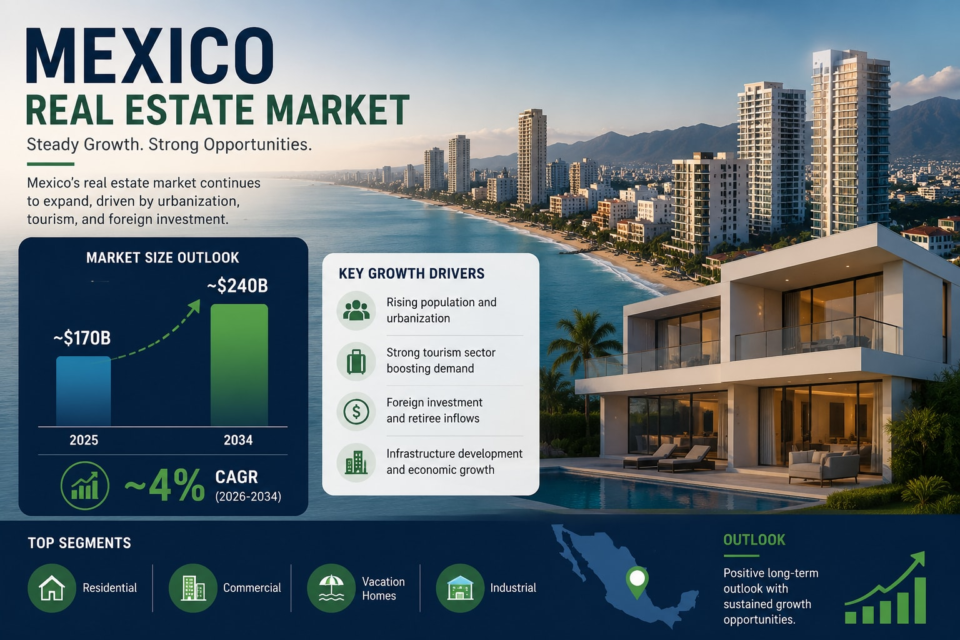
The Mexico real estate market is experiencing steady development driven by urban expansion, infrastructure upgrades, and changing lifestyle preferences. The market reached USD 168.9 Billion in 2025 and is projected to reach USD 238.9 Billion by 2034, growing at a CAGR of 3.93% during 2026–2034.
Growth in the sector is being shaped by technological adoption in construction and property management, along with increasing demand for modern residential and commercial spaces. Remote working trends are also influencing housing preferences, with more demand for flexible living spaces, suburban housing, and mixed-use developments. At the same time, industrial real estate is gaining importance due to manufacturing expansion and logistics network growth.
Overall, the market reflects a gradual shift toward smart infrastructure, energy-efficient buildings, and digitally enabled real estate services.
Download Sample Report Featuring 2026 Data and Future Outlook
Why the Mexico Real Estate Market Is Attracting Strong Investor Interest
The Mexico real estate market is gaining attention from both domestic and international investors due to its stable long-term growth potential and strategic location. Proximity to the United States makes Mexico an attractive destination for manufacturing-linked real estate development, especially in industrial and logistics sectors.
Another key factor is affordability. Compared to many global markets, property prices in Mexico remain competitive, offering higher potential returns for investors. This is particularly relevant in emerging urban zones where infrastructure development is ongoing.
Additionally, the growth of tourism and hospitality sectors is supporting investment in vacation homes, hotels, and rental properties. Investors are also looking at mixed-use developments that combine residential, retail, and commercial spaces to diversify income streams.
Key Trends Reshaping the Mexico Real Estate Market in 2026 and Beyond
Several important trends are shaping the future of the Mexico real estate market. One of the most significant is the increasing adoption of smart building technologies. Developers are integrating automation systems, digital security solutions, and energy-efficient infrastructure into modern properties.
Sustainability is also becoming a core focus. Green buildings with lower energy consumption and environmentally friendly construction materials are gaining demand among buyers and tenants.
Another emerging trend is the rise of mixed-use developments. These projects combine residential, office, retail, and entertainment spaces, offering convenience and improved land utilization in urban areas.
Digital transformation is also changing how real estate transactions are conducted. Online listings, virtual property tours, and digital documentation systems are making the buying and leasing process more efficient and transparent.
How Urbanization Is Driving the Mexico Real Estate Market Growth
Urbanization continues to be one of the strongest drivers of the Mexico real estate market. Increasing migration from rural to urban areas is creating higher demand for housing, infrastructure, and commercial facilities in major cities.
This population shift is also encouraging the development of modern residential communities with improved amenities such as transportation access, healthcare facilities, and retail spaces. As cities expand, demand for affordable housing and mid-income residential projects is also increasing.
Urban growth is further supported by government investment in infrastructure projects, including transportation networks, roads, and public utilities. These developments are improving connectivity and making new regions attractive for real estate development.
Mexico Real Estate Market Outlook Across Residential and Commercial Segments
The residential segment remains the largest part of the Mexico real estate market, driven by population growth and increasing household formation. Demand is strong for apartments, gated communities, and affordable housing units, particularly in urban centers.
The commercial segment is evolving with changing business requirements. Companies are increasingly looking for flexible office spaces, co-working environments, and technology-enabled commercial buildings that support hybrid work models.
Industrial real estate is also expanding due to rising manufacturing activities and the growth of e-commerce. Warehousing, logistics parks, and distribution centers are seeing strong demand as supply chains become more complex and globally integrated.
Foreign Investment Trends in the Mexico Real Estate Market
Foreign investment plays an important role in the Mexico real estate sector. International investors are attracted by stable returns, lower entry costs, and strong long-term growth potential.
Industrial and logistics properties are among the most preferred investment areas due to increased manufacturing relocation trends. Tourism-related real estate also continues to attract foreign capital, especially in coastal and resort regions.
Additionally, cross-border investment from the United States is increasing, supported by trade relationships and supply chain integration. Investors are also showing interest in real estate investment trusts and large-scale commercial developments.
Challenges Affecting the Mexico Real Estate Market Expansion
Despite positive growth, the Mexico real estate market faces several challenges. One major issue is rising construction costs, driven by increased prices of raw materials, labor, and transportation.
Regulatory complexity and approval delays can also slow down project development. Developers often face challenges related to permits, land acquisition, and zoning regulations.
Economic fluctuations and inflation may impact consumer purchasing power and investment activity. In some regions, infrastructure limitations such as inadequate transportation and utilities can restrict large-scale development.
Market competition is also increasing, requiring developers to differentiate projects through pricing, design, and amenities.
Opportunities Emerging in the Mexico Real Estate Market for Developers and Investors
The Mexico real estate market offers strong opportunities across residential, commercial, and industrial segments. Affordable housing development remains a major opportunity due to rising urban populations and housing demand.
Industrial real estate continues to expand, driven by manufacturing growth and logistics demand linked to global supply chain shifts. This is creating long-term opportunities for warehousing and distribution infrastructure.
Mixed-use developments are another growing opportunity, offering integrated spaces that combine residential and commercial functions.
Digital real estate platforms and proptech solutions are also creating new business models, improving efficiency in property management, sales, and customer engagement.
Overall, developers and investors focusing on technology-driven, sustainable, and strategically located projects are likely to benefit the most from the evolving Mexico real estate market.