
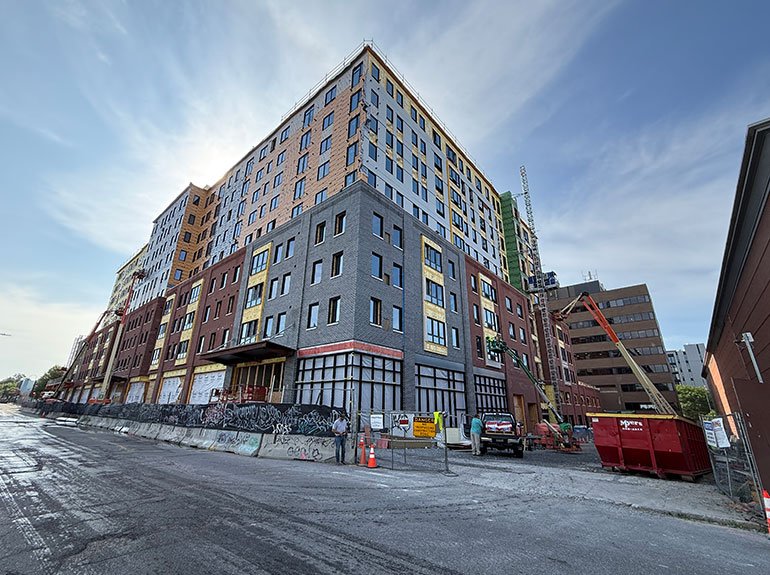

Construction continues in August on the 311-unit North Tower of CityPlace. VermontBiz photo
by Timothy McQuiston, Vermont Business Magazine
Vermont’s real estate landscape is defined by pockets of industrial and manufacturing strength, localized multifamily softening, and a persistent statewide shortage of affordable homes. The combination of high construction costs, elevated financing rates and shifting demand, specifically in rental properties, presents a moving target for developers.
According to multiple sources, public/private financing, regulatory clarity and strategic investments in site readiness and workforce development are the most effective levers available.
The state needs to accelerate permit reforms in designated growth areas. A new multi-stakeholder agreement intends to clarify development near wetlands.
Meanwhile, there has been measurable but slow progress toward closing the state’s housing gap, while sustaining commercial vitality in key sectors. Even office space vacancies have made some, if limited, progress in the Chittenden County area as BETA Technologies, the electric aerospace company in South Burlington, has gobbled up several empty spaces.
So far, rental housing inventory has improved as rents in some locations have receded somewhat and become more competitive. Housing units are increasing overall. However, Vermont will still need approximately 28,000 additional homes between now and 2030.
All of this comes as interest rates rise and inflation increases. Lenders are cautiously optimistic that those factors will not slow down the pent-up demand for housing now that inventory has loosened. The Fed raised interest rates a quarter point on September 16 and inflation has risen to 3.4%, much higher than their 2% target.
Commercial Real Estate
“2026 has been an interesting time for commercial real estate,” said Brad Worthen, Senior Vice President at Pomerleau Real Estate. “For Sale and Lease opportunities abound. However, buyers and tenants remain cautious as global uncertainties, the cost of borrowing, tariffs, slow tourist trade and Washington DC politics, among other distractions, shadow every possible transaction.
“BETA has been a major player when leasing available commercial locations in Chittenden and Franklin Counties, primarily focused on leasing warehouse/flex locations. This has helped drive the warehouse vacancy rate to an historical low. Only an estimated four warehouses of significant size (50,000+/- square feet) remain available for lease in Chittenden County. Other major leasing activity has come from sub-contractors for GlobalFoundries, concentrating their expansion efforts in Essex, VT.
“When it comes to retail, Williston takes the lead for leasing activity. The Church Street Market Place currently suffers from negative publicity with historic 12 +/-empty storefronts.
“Multi-family housing in Chittenden County is reaching a critical mass of slight oversupply. I can hear the housing advocates screaming now, but all one must do is look at the number of advertised apartment vacancies, reduced rents and incentives, dwindling higher education enrollments, and again Burlington’s negative press. This currently adds up to the highest multifamily vacancy rate in two decades.
“Looking ahead, if you’re a potential buyer or tenant, 2027 could be a prime opportunity to take advantage of commercial real estate. Economics 101 tells us that what goes up must come down…and eventually back up again.”
Yves Bradley, Principal at V/T Commercial, said:
“Our 2026 season has been another record year. That said, there seems to be a lot of uncertainty in the market, due to both national and state issues. In terms of residential, there appears to be oversupply, with too many new units coming to market at the same time. Retail shows strength in the suburban markets, but downtown Burlington is seeing vacancies go unfilled on Church Street and the associated side streets, which is a first. Industrial is doing well, but demand has cooled significantly since last year. As for office, there is movement, but a lot of downsizing. National firms are looking at how many people are in the office on a given day, and realizing that they are not utilizing or needing the amount of space that they did prior to COVID.
“BETA is indeed the juggernaut in the local market, and they have been buying up industrial properties in proximity to the airport at a brisk pace. It does not really affect the other properties in the region, but has done a great job of reducing available inventory in South Burlington and parts of Williston.
“As regards the rest of the state, there seems to be good activity in the Springfield market, which has shown signs of resurgence in the last 24 months. Likewise, Saint Albans is doing quite well and has little to no industrial inventory, which is also the case in Barre/Berlin/Montpelier. Part of that is the lack of new inventory.
“We seem to have reached an inflection point in our market where the cost to build new has exceeded the ability of the market to support those costs. That has had a significant impact on inventory as well.”
Bradley said Springfield has been a regional hotspot.
“There is a company there that has taken approximately 120,000 SF in the last two years in the former Fellows Gear Shaper Plant (the newer one on Precision Drive in the Industrial Park), and has expansion rights into the entire facility (385,000 SF).”
ImageTek, famous for its labeling technology, has grown as a collaborator and contract manufacturer.
In January, ImageTek announced a major partnership with the Apple Manufacturing Academy to develop an AIdriven Color Variation Quality Assurance Process — a system designed to improve color accuracy in label printing. As the company put it, “Color accuracy is more than an operational detail — it’s a promise.”
The collaboration produced a calibrated evaluation environment and a sustainable methodology for best-in-class labeling solutions.
ImageTek President Marji Smith described the partnership as “a collaborative approach rooted in curiosity and innovation,” underscoring the company’s commitment to precision manufacturing and continuous improvement.
In November 2025, ImageTek opened its expanded 40,000-square-foot manufacturing facility to host the launch of Ceres Air’s ‘Black Betty’ drone, a next-generation aerial intelligence platform.
The expansion itself was completed in an accelerated eight-week timeline, creating a modern, efficient production environment that impressed customers and partners alike.
As Smith put it: “Why not Springfield?” — a statement that resonated with attendees and highlighted the region’s manufacturing heritage.
Bob Flint of SRDC describes ImageTek’s growth as “the major business story of the year in our region.” With new investment in 2024 and multiple high-profile partnerships, the company is now a cornerstone of Windsor County’s advanced manufacturing ecosystem.
There has been much talk of converting excess office space into housing, but little action, Yves Bradley said.
“Lawson Lane in Burlington was purchased for that purpose, but there are a lot of (housing) units on the market now, and the vacancy rate is going down. This has also had an impact on rents, as tenants have more choice and landlords are more motivated. There are “for lease” signs up everywhere.”
Bradley said public/private financing has been the most successful path to multi-family housing.
“It seems to be the only way to make the numbers work at all. The cost of housing is staggering at this point, and is approaching $375.00/SF in the multifamily buildings. The non-profits are able to make sense of it, as they are usually able to have advantages fiscally.”
Housing
Aaron Stewart, owner of Stewart Construction, is generally optimistic about the Vermont construction industry. However, permitting, among other issues, presents an ongoing problem, he said.
“Housing projects continue to run into trouble. While construction costs have settled down a bit, it’s still expensive to build in Vermont; a combination of limited labor markets and expensive materials.
“We’re seeing many trade companies be bought up by VC’s or conglomerates, which then limits the competition to fewer and fewer companies. When you apply these market pressures to housing (a large dollar project with a long payback), it makes the financing even more difficult. The rental rates (especially outside of Chittenden County), can’t offset the construction costs, and it gets worse when you add in management and maintenance expenses.
“Until we start to see a balancing of the construction costs vs rental rates, I think that market rate housing will continue at its slow pace.”
Don Baker, Commercial Market President, Northern New England, for TD Bank U.S. said: “While affordability pressures haven’t disappeared, we’re seeing signs that some housing markets are beginning to stabilize compared to the volatility of recent years. Buyers are taking more time to understand the full financial picture, evaluate financing options, and determine what fits within their long-term goals. For many consumers, the path to homeownership may look different than it did a few years ago, but planning ahead and maintaining a long-term perspective can help make that goal more attainable.”
Matthew Wheaton, EVP and Principal at DEW Construction, believes that the efforts that state and local government, development advocates, and others have been putting money and effort into housing is paying off.
“We are seeing positive impacts. Additional funding sources, incentive programs, and public-private partnerships have helped advance housing projects and bring increased focus to one of Vermont’s most pressing challenges.
“That said, Vermont’s housing shortage was years in the making and will not be solved overnight. Continued investment, streamlined processes, and collaboration among public and private stakeholders will be necessary to increase housing production at the scale Vermont needs.”

Pines Apartments in South Burlington. VermontBiz photo.
Burlington Square/CityPlace
Johanna Schneider, Business Development Specialist with the City of Burlington, said Burlington Square, is the centerpiece of downtown Burlington development.
“The big news on Burlington Square/CityPlace is that the developers have now closed on the additional financing needed to complete the project.”
“The South Tower is substantially complete and occupied, and construction continues on the 311-unit North Tower. The current schedule anticipates completion by the end of 2027. Once complete, the two residential towers will include 364 apartments, including 73 permanently affordable units.”
The $200 million+ project has seen fits and starts since the central section of the former mall was demolished in 2018 and laid vacant until 2022. Even then the project went through several iterations. For instance, office space was stripped out of the project as the economy turned. Financing also became a greater issue as interest rates and construction costs increased.
Groundworks Collaborative
DEW Construction is serving as Construction Manager for the new Groundworks Collaborative Shelter, a purpose built facility which is nearing completion in Brattleboro. It will open this fall. The project represents a major investment in expanding and strengthening essential services for individuals experiencing homelessness in Windham County, while prioritizing safety, dignity, and long term sustainability.

Rendering of the new Groundworks Collaborative Shelter in Brattleboro. Photo courtesy DEW Construction
The project includes the new construction of a 10,720 squarefoot shelter facility designed to accommodate up to 40 individuals, replacing Groundworks Collaborative’s former 30 bed Morningside House with an enhanced and safer shelter program. The new building will better support both residents and staff through improved functionality, visibility, and program integration.
30 Permanently Affordable Apartments in Rutland City
In early August, the Rutland community celebrated the ribbon cutting of Maplewood Commons Apartments. Co-owners and co-developers Cornerstone Housing Partners and Evernorth partnered to develop Maplewood Commons Apartments, the new construction of 30 permanently affordable homes which provides essential housing and services for low- and moderate-income households near the city center of Rutland, Vermont.
Maplewood Commons Apartments transformed a vacant industrial site into a vibrant, newly constructed three-story building. Ten Project-Based Vouchers were provided by the Rutland Housing Authority with six apartments set aside for people experiencing or at risk of homelessness through the local Continuum of Care provider, the Homeless Prevention Center (HPC).
Mary Cohen, CEO of Cornerstone Housing Partners, said: “The completion of Maplewood Commons Apartments is an exciting milestone for our community and a testament to what strong partnerships can accomplish. These 30 new homes will provide safe, stable, and affordable housing for individuals and families
“Maplewood Commons Apartments represents how strong collaboration between nonprofit developers, municipalities and state and federal partners can create lasting positive change in our communities,” said Kathy Beyer, Senior VP at Evernorth. “We are so glad to be celebrating these new homes that will remain a community asset in Rutland forever.”
A mix of public and private funding totaling $14.6 million was raised to cover development costs. Evernorth’s Housing New England, Fund VI and VII provided a federal tax credit equity investment of $6.6 million for this project. VHFA provided a permanent loan of $1.2 million. The Vermont Housing and Conservation Board contributed over $4.5 million in federal ARPA funding, $1 million in national Housing Trust Funds as well as over $900,000 in state general funds. KeyBank provided construction financing. Other sources of funds include Green Mountain Power and Efficiency Vermont.
Mascoma New Markets Tax Credits
In late August, Mascoma Community Development (MCD) announced the closing of $9 million in New Markets Tax Credits (NMTC) financing to support the development of Shale Beach Condos, a new-construction affordable homeownership project in Burlington, Vermont, led by Champlain Housing Trust, Inc. Community Housing Capital (CHC) provided an additional $11 million in NMTC allocation, bringing the total NMTC allocation supporting the project to $20 million.
The transaction will help finance the development of a five-story residential building comprised of 30 permanently affordable condominium homes directly adjacent to the city’s Old North End neighborhood, one of the most rapidly changing and demographically diverse neighborhoods in the state.
“This project demonstrates how New Markets Tax Credits can support innovative housing solutions that expand access to homeownership,” said Tad Atwell, Chief Operation Officer of Mascoma Community Development.
This Champlain Housing Trust project, located within the Cambrian Rise neighborhood, represents a critical investment in expanding homeownership opportunities for low- and moderate-income households. The neighborhood is one of Vermont’s most economically diverse communities. Affordability pressures have been driven by significant increases in home prices and rents over the past two decades.
All homes financed in this project will be made available to households earning at or below 80% of Area Median Income and will remain permanently affordable through Champlain Housing Trust’s Shared Equity Homeownership Program model. This approach reduces upfront purchase costs, stabilizes monthly housing expenses, and enables homeowners to build equity while preserving affordability for future buyers.
“This is a great opportunity and perfect location to build new permanently affordable homes in what might be Vermont’s most economically diverse neighborhood,” said Michael Monte, CEO of Champlain Housing Trust. “These 30 new homes could not be built without the commitment from Mascoma and investments from other public and philanthropic partners.”
Robert Miller, CEO of EastRise Credit Union, said housing is the clearest example of a resilient real estate market.
“Vermont still faces a significant shortage of homes, whether for first-time buyers, growing families, or people looking to stay in the communities where they work. That demand is helping keep the residential market active. At EastRise, mortgage activity and home construction lending are both running ahead of last year, reflecting a market that is healthier and more active than it was in 2025.
“The reality is that many buyers have adjusted to today’s rate environment. While everyone would welcome lower rates, people still need homes. Life doesn’t wait for the perfect mortgage rate.”
The commercial real estate market is more mixed.
“We are seeing developers remain disciplined and selective. Higher financing costs, construction expenses, insurance costs, and labor challenges mean projects must make economic sense before moving forward. Some permitted projects have slowed, not because demand has disappeared, but because developers are taking a closer look at the numbers and making sure projects remain viable over the long term.
“That said, not all sectors are experiencing the same challenges. Multifamily housing and industrial development continue to show strength, while office and some retail properties face greater headwinds as businesses and consumers continue to adapt to changing work and shopping patterns. EastRise’s market analysis shows vacancies remain elevated in office and retail, while industrial space continues to experience strong demand and limited supply.
“The encouraging news is that Vermont is becoming more focused on solutions. State leaders, developers, lenders, employers, and community organizations all recognize that expanding housing supply is critical to the state’s future economic success. Programs aimed at supporting housing development are helping create additional opportunities, even if progress is slower than many would like.
Joseph Bator, President of Northfield Savings Bank, said:
On the residential mortgage side, we continue to see interest from strong, well-qualified borrowers, but affordability is clearly the challenge. Vermont simply does not have enough housing supply, and that puts pressure on buyers before they even get to the question of rates.
For many, the combination of price, inventory, and monthly payment makes it difficult to move forward. We are also seeing homeowners with equity consider renovations, and home equity options rather than moving, especially if they currently have a low-rate first mortgage.
The current expectation is for rates to remain stubbornly high heading into 2027. This will continue to create headwinds for homeownership and the affordability of new construction.
Commercial real estate is a little more mixed. There is still activity, especially around housing-related developments, smaller commercial spaces, adaptive reuse, and projects connected to education, infrastructure, and community needs.
Traditional office space continues to be more challenging, which is not surprising given the longer-term impact of hybrid work and changing space needs.
Additionally, there are several large projects in Burlington that are expected to come online in 2027 which will put pressure on existing properties as tenants can and often choose to move to newer and potentially better located addresses.
Ken Countermine, Head of CRE Banking and Capital Markets, Community Bank, said: “Commercial real estate and residential lending remain active for qualified borrowers and well-structured projects.
“While underwriting standards remain focused on repayment capacity and leverage, we continue to see borrowers moving forward when the underlying economics support the investment, whether it’s the first-time homebuyer or the commercial developer of an industrial facility. That trend is consistent across much of the Northeast, including Vermont.”
Vermont Housing Finance Agency
Maura Collins, Executive Director of the Vermont Housing Finance Agency, also sees an easing of housing pressures.
“From a housing market perspective, we are seeing some signs that conditions are becoming less strained than they were at the height of the pandemic, but it would be premature to say Vermont’s housing challenges have been resolved.”
“While there is modest improvement in some ways, the overall shortage of homes remains a significant issue, particularly for low- and moderate-income Vermonters. Or to put it another way, the market is less overheated than it was during the pandemic, but the underlying housing shortage has not gone away.”
A few data points help illustrate that picture:
- In 2026, median rents across Vermont increased while median income declined relative to the prior year, according to HUD estimates. That means many Vermonters continue to face affordability challenges despite some changes in market conditions.
- Rental availability has improved compared to the exceptionally tight conditions seen during and immediately after the pandemic. However, the most recent estimate for Chittenden County’s rental vacancy rate is 3.3%, which remains below the roughly 5% vacancy rate generally considered necessary for a balanced market. More units are available today than a few years ago, but vacancy rates remain relatively low by historical standards.
- The homeownership market is showing signs of gradual stabilization. Homes are staying on the market slightly longer than they were a year ago, suggesting somewhat less competition among buyers. Even so, inventory remains limited and many households continue to struggle to find homes they can afford.
- One important point is that Vermont’s housing needs are driven by more than migration patterns alone. Even with little or no net population growth, Vermont continues to add households because household sizes are getting smaller. As a result, demand for housing continues to grow.
- VHFA estimates that Vermont will need approximately 28,000 additional homes between 2025 and 2030, yet current production trends suggest the state is on track to build only about half that amount. This ongoing gap between supply and demand continues to put pressure on both the rental and homeownership markets.
- The challenges are especially pronounced for lower-income households. Between 2025 and 2030, Vermont is estimated to need roughly 15,000 additional homes affordable to households earning 80% of median income or less. Demand for these homes continues to outpace production.
“So I’d say Vermont’s housing market is no longer experiencing the extreme conditions of the pandemic era, and there are encouraging signs of greater stability. At the same time, housing affordability and overall housing availability remain significant challenges. The state’s long-term solution remains increasing the supply of homes across a range of price points, especially homes affordable to Vermont workers, families, and seniors.”
In August, Fitch Ratings assigned a ‘AA+’ rating to the following Vermont Housing Finance Agency (VHFA) multiple purpose bonds: The Rating Outlook is Stable.
Meanwhile, Vermont ranks second in housing vacancies, at nearly one in five, according to LendingTree. In the US as a whole, about one in 10 homes sit vacant.
In Vermont, 76% of vacant homes are seasonal/recreational, leaving about 1 in 7 homes empty in the offseason. Maine has the highest vacancy rate at 21%, followed by Vermont (19%), Alaska (18%), West Virginia (15%) and Florida (15%). Connecticut is lowest at 7%.
LendingTree’s Matt Schulz, said: “For consumers frustrated by today’s housing market, these numbers can be confusing. Millions of homes may be classified as vacant, but most aren’t realistically available for someone looking to buy. That helps explain why so many buyers continue to face limited choices and stubbornly high prices, even when it seems like there should be more homes on the market.”
AGC’s Richard Wobby said: “Housing is still the biggest example of Vermont knowing exactly what the problem is but struggling to get enough built.
“Every employer feels it. Every contractor feels it. Every hospital, school, municipality, nonprofit, and small business feels it. We cannot grow our workforce if workers cannot afford to live here. We cannot talk about economic development and then make it nearly impossible to house the people we need.
“There is demand for multifamily housing, workforce housing, senior housing, mixed-use projects, adaptive reuse, and rehabilitation of existing buildings. But there are still too many barriers between a good housing idea and a completed housing unit.
“The Legislature has taken steps with the HOME Act, Act 181, Act 69, and more recent changes around Act 250, housing infrastructure, and local zoning. The state has also recognized the need to address permitting, infrastructure, zoning, and construction incentives.
“That is progress, but we need to be honest. Passing a law in Montpelier is not the same as handing someone the keys to an apartment. The impact has not fully reached the jobsite yet. AGC/VT supports reforms that make it faster, clearer, and more realistic to build housing in places where we already have roads, water, sewer, schools, and services.”
Meanwhile, Wobby said commercial construction is “a mixed bag.”
“Traditional office space is not what it used to be, but there is activity in healthcare, education, manufacturing, hospitality, municipal buildings, energy, and adaptive reuse. Businesses are being careful because costs are high, financing is tighter, and nobody wants to get halfway into a project only to find out the numbers no longer work.
“But commercial construction still matters. When a business invests in a building, expansion, or facility upgrade, that is a vote of confidence in Vermont. Housing is critical, but we cannot forget the commercial side. We still need places for people to work, receive care, learn, manufacture, buy goods, and grow businesses.
“If Vermont only talks about housing and forgets commercial development, we miss a big part of the economy.”
On the permitting front, The Vermont Agency of Natural Resources (ANR), the Vermont Natural Resources Council (VNRC), Conservation Law Foundation (CLF), the Lake Champlain Committee (LCC), and Let’s Build Homes (LBH) announced in early August a Joint Statement of Commitment laying out a shared roadmap for reforming Vermont’s wetlands permitting system.
The agreement charts a series of short-, medium-, and long-term actions intended to accelerate housing production without compromising the protection of significant wetlands that provide Vermont with flood storage, drought resilience, clean water, and wildlife habitat.
The roadmap includes an impactful immediate change – a new, temporary ANR rule that will reduce the size of wetlands buffers in the state’s designated areas starting August 8 – and a commitment to attempt to codify critical elements of the agreement in legislation in 2027.
“This roadmap reflects months of hard, honest conversations about how Vermont can balance its urgent housing shortage and the environmental benefits of compact settlement against the need to safeguard wetland functions,” said ANR Secretary Julie Moore. “Completing these reforms will provide greater regulatory certainty for builders and municipalities, while ensuring ANR continues to protect wetlands that are critical to flood resilience and clean water. We appreciate Let’s Build Homes, VNRC, CLF and LCC working with us to find real, durable solutions.”
Most noticeably in the short-term, the agreement sets a 25-foot buffer within defined designated growth areas for projects registered with ANR on or before January 1, 2030, as set forth in the proposed amendments to the Vermont Wetland Rules effective August 8, 2026.
It also allows for development of a general permit to allow fast-tracking for housing and mixed-use development that includes housing with minor wetland impacts statewide. And it would improve wetlands maps and eventually establish a streamlined wetland mitigation system for unavoidable buffer impacts resulting from housing and mixed-use development in designated growth areas.
CHT, Evernorth, Sanders mark completion of affordable apartments in Burlington
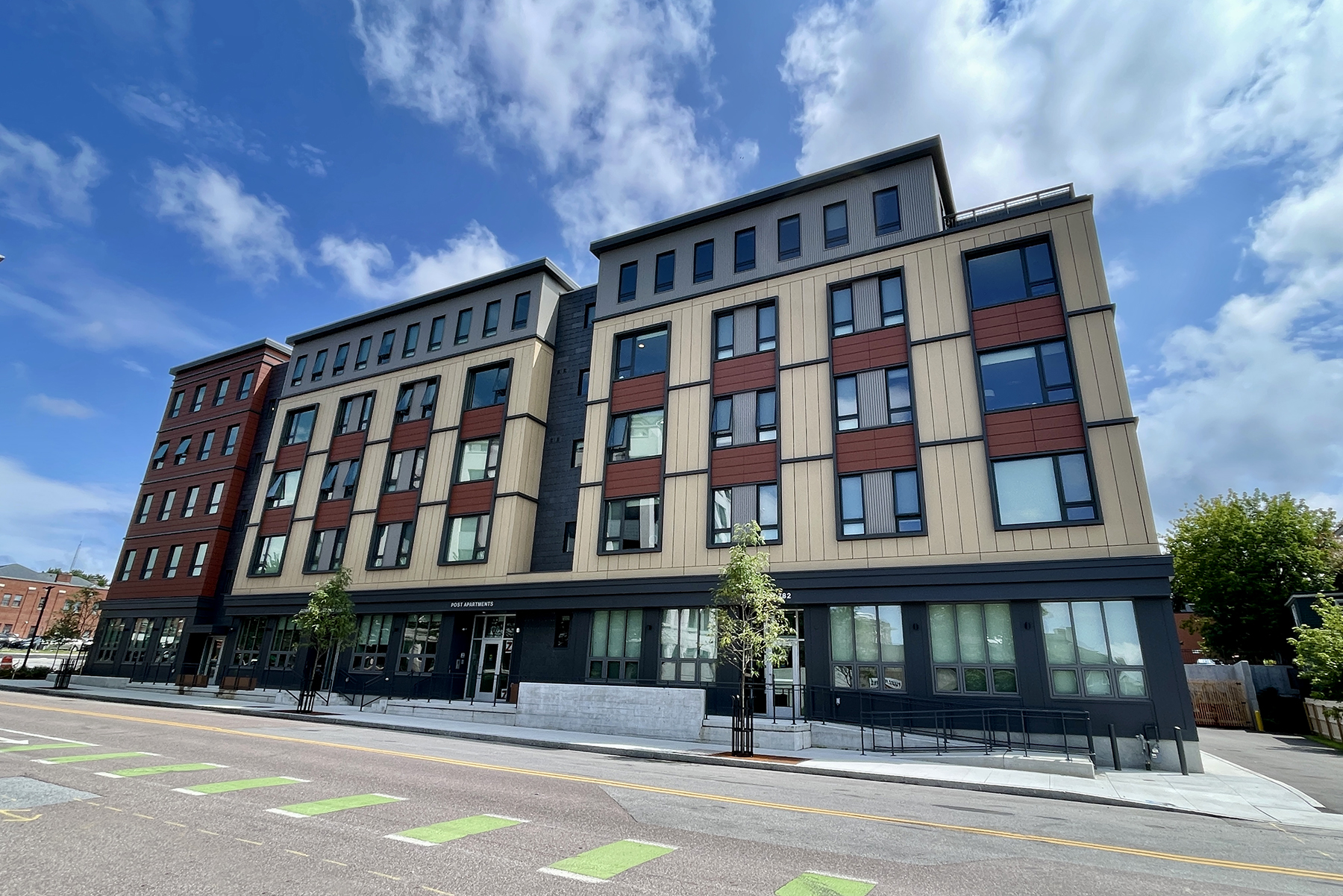
Senator Bernie Sanders headlined a ribbon cutting event September 4 marking the completion of 38 permanently affordable apartments, a new Veterans’ Center, and space for the Chittenden County Community Justice Center. The Howard Plant VFW Post 782 sold the building to the Champlain Housing Trust to make way for the new development and will operate out of the building. Evernorth was a co-developer of the building.
“Throughout our state, too many Vermonters are being squeezed between stagnating wages and the skyrocketing cost of housing,” said Senator Sanders. “That is why I fought to secure $1 million in Congressionally Directed Spending to help create this permanently affordable housing, which includes apartments reserved for veterans and a veteran’s service center. Decent and affordable housing is a human right. Period.”
Post Apartments includes 38 apartments with nine set aside for people experiencing homelessness – and four of the apartments are occupied by Veterans. Champlain Housing Trust’s resident services team will support tenants and connect them to other resources in the community. The building is fully occupied.
The Howard Plant VFW Post 782 approached the Champlain Housing Trust and the City five years ago to discuss how to redevelop the property while preserving access to a center for Veterans. That initial vision developed into what is here today. Post Apartments includes eight efficiencies, 26 one-bedroom apartments, and four with two-bedrooms. The VFW and Chittenden County Community Justice Center occupy a combined 6,800 square feet of space on the first floor.

Evernorth photo.
“Redeveloping a small site in the middle of Burlington doesn’t come without it’s challenges and costs,” said Michael Monte, CHT’s CEO. “But it’s the perfect place for housing and the VFW Post 782 had a vision and determination that was contagious. Many of the people who have moved in work for downtown businesses and local nonprofits, serving the community. We’re proud to serve them in return.”
The rents for the apartments are affordable for single person households that earn up to $62,400, and include all utilities, including heating and cooling. The building is fully electric and has solar panels on the roof. Rents start at $1,160.
The site is next to a gas station and adjacent to where the City decommissioned an old sewer in a ravine that runs through the neighborhood, leading to significant environmental remediation and additional engineering costs. About $1.6 million in financing through the Brownfields program was dedicated to the site cleanup. The location is ideal: with all the shops and stores downtown accessible right out the front door.
“When communities like the City of Burlington say ‘yes’ to housing, the outcome is Post Apartments,” added Kathy Beyer, Evernorth’s Senior Vice President for Real Estate Development. “We are thrilled to be opening the doors to 38 new homes right in downtown Burlington.”
The redevelopment of the property was financed by more than 20 funding sources adding up to about $24 million, including the first floor commercial space, with $1 million through U.S. Department of Housing and Urban Development Community Project support secured by Senator Sanders. The City allocated roughly $3 million from various local and federal funding sources, including a $1 million grant award from federal American Rescue Plan Act (ARPA) funds. NeighborWorks America made a $365,000 grant.
The Vermont Housing & Conservation Board awarded approximately $9 million from state and federal sources, including $6.9 million from ARPA-State Fiscal Recovery funds, $1.4 million from an appropriation through the State of Vermont’s budget, and $595,000 from the National Housing Trust Fund – a program originally sponsored by Senator Sanders. Federal Tax Credit Equity administered by the Vermont Housing Finance Agency (VHFA) and provided by Evernorth’s 481 Fund II contributed by TD Bank, totaled over $6.4 million, and Vermont’s Affordable Housing Tax Credit added another $463,500.

CHT courtesy image.
Handy buys Taft Corners landmark
In August, Williston Observer reported that the Handy family, a prominent Burlington-area landowner, bought a 4-acre parcel at the prominent Taft Corners for $3.5 million. The large parcel includes two large office buildings, the historic Blair House and the Texas Roadhouse restaurant.
TD Bank had foreclosed on the property. The bank attempted to auction it off last fall, but there were no suitable buyers, the Oberserver reported, and it held onto it over the winter. Five members of the Handy family incorporated as Estier Investment Group LLC then bought it . The paper said they plan to restore the 1840s building, which was once a tavern.
Investors pour $19 million into transforming Burlington hotel
In July, Westport Hospitality completed a year-long, $19 million top-to-bottom renovation that converted the former Courtyard by Marriott Burlington Harbor Hotel into an independent, design-forward lakeside retreat called The Harborvale. It will provide about 100 jobs.
Spearheaded by local owners Chuck DesLauriers and Jay Canning of Westport Hospitality, the Burlington-based hotel management company behind Hotel Vermont, said the project reflects a deep commitment to the city’s downtown waterfront economy.
“This project represents far more than a physical renovation; it’s a direct reinvestment in Burlington’s workforce and downtown core,” said Hans van Wees, Managing Director of Westport Hospitality. “By bringing the Autograph Collection to Lake Champlain, we are pairing world-class hospitality with deep Vermont roots.”
To support vital journalism, access our archives and get unique features like our award-winning profiles, Book of Lists & Business-to-Business Directory, subscribe HERE!
 Vermont Business Magazine