
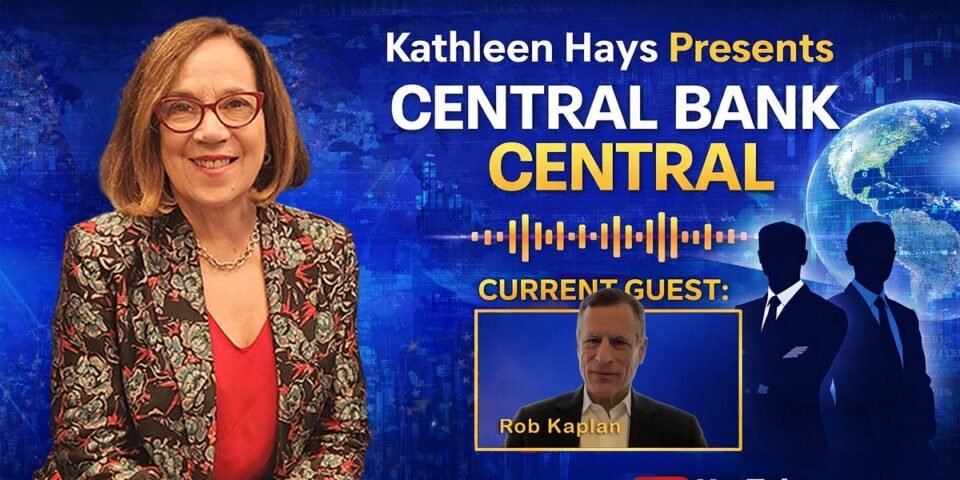
What is driving the bond market selloff that has pushed the yield on the U.S. benchmark government’s ten-year Treasury note to its highest level since 2002? How much is it uncertainty over how many rate hikes the Federal Reserve will have to do to beat back inflation? How much is it the AI investment boom spurring a seemingly endless demand for capital? How much is it the ever-rising U.S. fiscal deficit?
Enter Robert Kaplan. As vice-chairman of Goldman Sachs, and former president of the Federal Reserve Bank of Dallas, he brings years of experience in the world of Wall Street and of Fed policy making to look at all sides of the question.
”I’ve not heard a fiscal plan for deleveraging. All of your growth is going to have to come from productivity growth. And we want to get paid more to buy duration,” Rob says.
”We’re leveraged 50% debt to GDP. When you’re this highly leveraged, I think if there’s a risk premium built into the Treasury market, even in the one and the two year and the three year, I think communication is a good thing to try to get some of that risk premium out of the market, because it’s very expensive when you’re this highly leveraged at the government level.’
“There’s a global infrastructure boom, particularly in the US that is demanding capital. And maybe we’d rather buy the ten year with a corporate credit, and get paid to spread over treasuries than to buy the government bond.”
Rob points out that the short-term bond yields “are a different matter… more tied to what’s going on, I would argue, with the Fed and inflation.”
”And you’ll notice that the front end of the curve has leapfrogged what the Fed indicated it might do in the dot plot, and is built in an extra 50 basis point plus cushion beyond what the Fed might reasonably indicate it’s going to do.”
Rob gave several reasons why the bond market was making bigger bets on the number and size of rate hikes than the FOMC itself made at its September meeting starting with Fed chair Kevin Warsh. “Maybe it’s still trying to decipher Warsh and the communication
He takes issue with those arguing that the bond selloff is becaue of a strengthening U.S. economy.
Talking about economic matters, Rob says, ”If it’s AI related, it’s strong. If it’s defense spending related, the economy is strong. If it’s interest sensitive or related to housing, autos, low moderate income, the consumer economy is relatively sluggish,” Rob says.
He says this may have been the reason why the Fed’s reaction function has been muted so far in this rate-hiking cycle. “But it’s also aware that raising the fed funds rate will not slow the AI build out, the infrastructure build, and it may in fact further slow areas of the economy that I believe are already sluggish. So, that’s a balancing act they’re trying to do, I believe.”
Rob also points to changes in the drivers of the economy and debt markets that the Fed is not used to navigating the way it has to do now.
”So there’s an irony right now, ten-, fifteen-years ago, you would say the safest thing you could own is long duration government bond,” he says. “And it’s a risk stabilizer, has a cyclical component. Today because we’re so highly leveraged, I think you’re not seeing the cyclical quality in the long end of the curve, but you are seeing , despite all these headwinds, companies… able to improve their earnings.”
For the Fed, “the punch lne is that they are operating in a different kind of economy than they are used to navigating.” Rob says an overheating labor mraket, an overheating consumer-led economy was what drove them to hike rates in the past. “That’s not this economy.”
”This is an economy that’s being powered by a CapEx boom against tariffs, restrained labor growth and energy shock, which has been persisting. And, the Fed’s not accustomed to what’s the role of increasing the Fed funds rate or adjusting monetary policy with this kind of setup.”
So dive in and hear why Rob would have been on board with the FOMC’s decision to raise its key rate in Septmber, in favor of skipping another hike in October, and prepared to do another hike in Decmber — adding that this will “require a lot of thinking” by the Fed.
Spoiler alert: Speaking about the December decision, Rob says, ”I actually think I’d want to be out with contacts, not relying just on data because it doesn’t tell the whole story. I have a job where I’m out with companies constantly, and I think you’re seeing it’s a more mixed economy than you might guess if you’re just looking at data.
The bond market selloff 00:01:00:19
So this is a global issue where by and large, with a few exceptions, countries around the world are historically highly leveraged. A Europe France is an example. China’s got a leverage issue. Japan and certainly the United States. And the issue is we don’t have workforce growth, you know, deglobalization and lack of receptivity to immigration, for example, in the US has limited workforce growth and deportations of existing workers who are here on provisional status.
Slowing or shrinking populations & workforces 00:01:35:16
So if you want to deliver at the government level, how are you going to do it? You have to grow the workforce. You have to grow productivity. And we and we don’t have workforce growth. By and large, this Europe’s got the same aging issue. China’s got a worse aging issue than we do. Japan is shrinking. And so you’re seeing duration government duration buyers saying you’re highly leveraged.
NO fiscal plan to de-leverage 00:02:03:11
I’ve not heard a fiscal plan for deleveraging. All of your growth is going to have to come from productivity growth. And we want to get paid more to buy duration. And then the one other thing going on. There’s a global infrastructure boom, particularly in the US that is demanding capital. And maybe we’d rather buy the ten year with a corporate credit than get paid to spread over treasuries than to buy the government bond.
Front end has leapfrogged Fed ‘guidance’ 00:02:33:16
And so having said all that, you’ve had a big move up in the government bonds at the back end, on the front end is a different matter. The front end is more tied to what’s going on. I would argue with the Fed and inflation, how much the Fed is going to do. And you’ll notice that the front end of the curve has leapfrogged what the Fed indicated it might do in the dot plot, and is built in an extra 50 basis point plus cushion beyond what the Fed might reasonably indicate it’s going to do.
Markets anticipating higher rates for longer 00:03:12:11
And there’s a few reasons for that. One, maybe it’s still trying to decipher Warsh and the communication and predicting what they’re going to do in their reaction function. And the second thing is, I would argue the curve is reflecting a risk that energy prices and diesel, etc. are going to stay elevated for longer than may have been anticipated. If that were to happen, that’s going to have an upward effect on inflation. And maybe central banks around the world, including the Fed, will have to do more.
Economy is mixed and rate hikes will have mixed impact 00:04:20:12 –
But this is this issue has been we’ve been vulnerable this for a while, and it’s been going on for a while. And some people are attributing the backup to strong growth, I would argue. I wish that were the case. Maybe it is, but I think the economy is more mixed. If it’s AI related, it’s strong. If it’s defense spending related, the economy is strong. If it’s interest sensitive or related to housing, autos, low moderate income, consumer economy is relatively sluggish. And that’s the reason why I think the Fed’s reaction to all this going on has been more muted than some might have expected, because it’s aware that a rate increase, may slow the transmission of diesel and the energy shock to the economy to other items. But it’s also aware that raising the fed funds rate will not slow the. I build out the infrastructure build, and it may in fact further slow areas of the economy that I believe are already sluggish. So that’s a that’s a balancing they’re trying to do I believe.
Front end and back end forces & dynamics are different 00:06:08:22
So let’s separate the back end of the treasury curve and the front end. So the back end, which is what drives more the longer duration bonds, drives mortgage rates. A lot of the AI capital is a little bit longer duration. The front end, i.e. the one year, the two year and the three year are more driven by expectations of inflation and what central banks, including particularly the Fed, are likely to do.
Home builders face multi-dimensional pressures 00:06:38:17
And so I think there are two different discussions here. The issue about the Fed raising the fed funds rate in housing is a good example. If I’m a homebuilder, it’s harder to sell a home. It’s harder for new buyers to afford a home because of tariffs, shortages of labor. And this energy spike cost to build the home has gone up. And now I’ve got a new problem. At least I could finance my inventory at the fed funds rate, at a Fed, at a floating rate that was based on a lower fed funds rate. Now, with the Fed raising rates now, it’s harder for me to hold the inventory. And so we’re seeing people getting squeezed in homebuilders.
A squeeze for all of real estate 00:07:30:01
I can tell you real estate related across the board people are getting squeezed. And it’s it is affecting interest sensitive industries. And we’re seeing that it is not, again, going to affect the hyperscalers very much. And so the other comment I would make that’s going on beneath is further complicated, because I spend my life broadly with companies, institutions…
Corporate profitability is on the rise 00:07:59:16
The share of GDP going to profit is going up okay. Share of GDP going to labor is more muted. So that’s a nice way of saying even though real GDP growth is only two and a quarter, 2.5% S&P earnings growth is double digit okay. And that’s driven by the hyperscalers. And I think the prospect that companies are going to be able to use productivity enhancing tools powered by AI to grow revenues without growing their headcount. And so if you own equities during this period, you’ve done reasonably well. A
A changed cyclical investing theme 00:08:43:11
So there’s an irony right now. Ten, 15 years ago, you would say the safest thing you could own is long duration government bond. And it’s a risk stabilizer, has a cyclical component today because we’re so highly leveraged. I think you’re not seeing the cyclical quality in the long end of the curve, but you are seeing despite all these headwinds, companies be able to improve their earnings.
…and this will have legs; it’s a different setup 00:09:11:16
And I think this trend is going to go on for the next few years. The Fed is watching all this. And the point ,the punch line is this is a different type of setup than they’re used to. They’re used to overheating labor markets very tight. Maybe it’s overheating consumer led economy very strong. And we’re going to adjust the fed funds rate result. That’s not this economy I don’t think I don’t think you’re seeing an overheating. The consumer is resilient. But not I don’t know how much strengthening because of low-income consumers. This is an economy that’s being powered by a CapEx boom against tariffs, restrained labor growth and energy shock, which has been persisting. And, the Fed’s not accustomed to what’s the role of increasing the Fed funds rate or adjusting monetary policy with this kind of setup.
Not a situation for knee-jerk response 00:10:12:08
And I think it’s why it’s requiring a lot of thinking. And this is why the punchline is I would have raised rates in September, I would skip October. I’d be prepared to raise again in December. But I actually think I’d want to be out with contacts, not relying just on data because it doesn’t tell the whole story. I have a job where I’m out with companies constantly, and I think you’re seeing it’s a more mixed economy than you might guess if you’re just looking at data.
Higher leverage makes higher rates more painful 00:11:25:08
I hear arguments and I think they’re worth there. And I agree with them. However, the two cautions in periods where rates were higher, workforce growth was stronger, and overall GDP growth, at least to me, looked better. Okay. Number one. Number two, we are dramatically more highly leveraged at the government level than we were when those rates were higher. And so rates being marked up to this level are much more painful when you’re leveraged over 100% debt to GDP. Another way to say this a lot’s been discussed about Greenspan and how he handled things. Debt to GDP in the United States when Greenspan was running the Fed was in the low to mid 50s. Okay, is a different world, different worlds.
…and weaker growth less open borders, less dynamism 00:12:25:24
And growth was better. Growth was better because we had better workforce growth. And we had we had immigration in addition to supplement. And so I think those are two factors that are that are worth considering here. And I think it’s part of the package that again, if I’m at the central bank, you have to think about . So before the AI boom started…I think most folks at the Fed and people I talked to in my own two cents is the real fed funds rate was probably 0.75% to 1%. Okay. By the way, go back to the 90’s when workforce growth was stronger. I think the neutral rate was meaningfully higher because growth potential of the US economy was higher.
Fed must come to terms with what AI and productivity mean 00:13:43:01
All right. So now we get to this AI capital boom and demand for capital has spiked. And so it’s logical that that would be increasing. And the improved productivity might be increasing somewhat the neutral rate. This will be debated and discussed I would imagine regularly for the next year or two. And I know Kevin Warsh has said it’s not relevant, but it kind of has to be relevant if you’re trying to figure out whether you’re accommodative or neutral or restrictive.
Strong investment demand drives up the cost of money…& more 00:14:18:05
So what’s the likely neutral fed funds rate now? Maybe it’s inched up to one and a quarter. One and a half. We don’t know. But it’s something to think about in light of this excess demand for capital. It’s logical that the equilibrium price of money would be going up. When you’ve got this kind of demand for capital and it’s something to consider.
Warsh is learning and seeing the market react to his new ideas 00:15:42:04
So remember I come at this as someone who, yes, was at the Fed for six plus years but… most of my career has run businesses and I’m a business person. So I come up from a leadership point of view and what strikes me, Kevin Warsh has been in the job now what four-ish five months. He’s – and appropriately- he’s learning. And you’ve seen it from the June meeting to the July press conference to Jackson Hole to September. He’s refining his communication. So that’s part one. You know, he may even be in his own mind reframing what he what he wants out of the task forces, wouldn’t surprise me… But here’s the point. And we saw it over the last few weeks. We saw that if you don’t have a lot of communication and people are uncertain about your reaction function, sometimes the market goes where it’s guessing you’re going, and it can be wrong.
Go your own way has its limits and costs 00:16:56:16
And this is why this issue- I know it’s been commented on, we want to take signals from the markets. I got to tell you, as a person who’s been in the markets this whole life, I’d be very careful about going too far with that. The markets can change on a dime. Okay. And the markets are taking signal from these other structural factors and from you.
Markets can misread Fed intentions 00:17:17:14
I’d be paying attention to the markets, but I think the last two weeks was a good example, where the markets jumped way out ahead of what I think the Fed was thinking about doing even in October. And I think because several speakers went out there and communicated, I think it got back in a better place. But I think there’s a good lesson in that, which I would guess.
Any risk premium is going to cost the government dearly 00:17:41:06
Kevin Warsh has watched this episode very carefully, and I would guess he’s going to refine how much you don’t want to be telling people. He doesn’t want to tell people what you’re going to do, but you got to give them some better sense of your reaction function, how you’re thinking. So why in the economy that’s leveraged over 100% debt to GDP, where we’re struggling to sell long duration bonds, where we’re rolling over the debt stack more regularly, if there’s a 50-basis point or 40 basis point premium, even in the front end of the curve, it’s expensive as all get out.
This is about helping the government not about monetary policy…00:18:22:12
You with me? You know, again, when Greenspan was running the Fed and I think actually we had a pretty good sense I was in the business at the time. We had a pretty good sense of where he’s coming from, but we were so much less highly leveraged. We’re leveraged 50% debt to GDP. When you’re this highly leveraged, I think if there’s a risk premium built into the Treasury market, even in the one and the two year and the three year, I think communication is a good thing to try to get some of that risk premium out of the market, because it’s very expensive when you’re this highly leveraged at the government level.
Fed should be aware– 00:18:58:00
And so I wouldn’t be surprised if there isn’t some thinking about that inside the Fed. There ought to be.
Is Warsh learning and changing his mind at all? 00:19:09:14
I think he’s learned I think he’s learning from it. And I would guess he’s learned a few lessons and maybe refining his thinking based on what even happened the last 3 or 4 weeks.
Waiting on the task forces 00:19:50:16
Well, let me let me tell you an order. First of all, I think it’ll be helpful when Jeremy Stein and the task force and the balance sheet comes back. And I think and I think people are already realizing this, I think to the extent the Fed makes movements on the balance sheet, they’re going to be very gradual and not abrupt.
Lots of debate on this issue of Balance Sheet 00:20:09:20
Okay. Maybe over many years they’ll have a goal to equalize the average maturity of their balance sheet with average outstanding, but not abruptly. And I think the market’s already gotten that sense. I think that that’ll be helpful. Apart from that, I think debate and disagreement within the Fed is you’ve always heard me say is a is a good thing okay.
Does Warsh have a number two? 00:20:34:03
But I also think it’s helpful if the chair has a couple of lieutenants, probably at the governor level, who can go out there and refine the message when needed.
40-trillion constantly re-pricing 00:20:48:24
Particularly in the economy, that that has got where you pick the number 40 trillion of outstanding debt that needs to keep getting regularly rolled over. I think you can do some on the front end of the curve to help. Maybe take a little bit of the confusion out of the front end of the curve, especially when the US government is financing more and more. Not in the long end, but at the front end of the curve. And so but the chair doesn’t need to be the one to do that, him or herself, all the time. But I think it helps if you have a couple lieutenants. And that’s where the Fed chairs have typically operated. Either send out a Jefferson or a Williams, and the issue is how tightly are they coordinating on that front.
Fed chair needs to have options 00:21:37:21
That is historically been the way Fed Chairs have operated. And I think that’s a decision for Chair Warsh. But I think he may be well served by when you see things are a little out of whack in a world that’s this highly leveraged, you may want to have the ability to, to, to tamp down some confusion or excess risk premium in the debt markets and the Treasury market.
Dollar is well underpinned 00:22:31:03
I think I think the dollar has maintained resiliency for a couple of reasons. One, we’re energy self-sufficient. And we were reminded in the last year how valuable that is. Number two, the AI trade and the AI infrastructure build, I would guess, is probably adds to dollar resiliency in that capital is coming here to invest in AI and lent AI infrastructure build up.
Reserve currency role of the dollar might survive 00:23:01:10
And then secondly, the people we buy from, overseas,
Policymakers must never forget how leveraged we are 00:24:06:17
And we’re growing this year at a 5% nominal rate. The year we just ended and the deficit went up. And I think that’s of concern. And so you’ve just got to keep in mind when you’re a public official, now that the country at the government level is a lot more highly leveraged than we were. And I think you’d make a mistake not to have that in the back of your mind.
The corporate approach 00:24:43:06
What let’s let’s take it across the board for companies. Companies. In a typical board meeting, we’re discussing all the issues you and I just discussed for about five minutes. And then most of the conversation is how do we adapt to AI and adoption and disruptive threats, and how do we build this, the distinctive value as a company, and do we need to merge or we can go it alone?
Must ask how will government policy affect YOU 00:25:08:03
That’s the conversations going on at corporates. They’re focused, very focused as focus have ever seen on how to build their business and how with AI’s role in it, if you’re an investor, ironically, and again, in a world where a share of GDP going to profit is going up and but there’s a question about how governments are going to finance this debt, this is where public equity markets are being also very resilient.
Should you deleverage in a time of leverage? 00:25:37:00
If you’re a diversified, broad portfolio, I think people are more hesitant to buy duration. There’ll be a level of yields at which they’ll lay on the long end, will they begin to nibble. But they’re a little more careful. They’re shortening duration. And the last comment I would make, which you haven’t asked about, is if you’re highly leveraged in a world we’re in right now with this amount of disruption and with all the dynamics on the debt curve, you might be well served to be less leveraged and find ways to deleverage.
The deficit keeps on rolling in 00:26:13:18
And absolutely. And I’m seeing that widespread is because the risk of a seemingly unforeseen disruptive event that changes the outlook for your company seemingly overnight is increasing. You can adapt to it, but you don’t want to be as highly leveraged. But what’s the big tail risk in all this? The tail risk, again, is we’re just finished the year ended 9/30, 2026 with a $2 trillion plus deficit.
Is the war sapping our financial flexibility? 00:26:50:16
Every analysis that I’ve seen leading up to before this had suggested that if you’re, if growth, if nominal GDP growth was 5%, we should be bending down the deficit. That’s a high level of nominal growth. So it tells you that that we’re really struggling at the government level. Maybe it’s the war, maybe the war costing dramatically more than we understand.
Will take effort to get a fiscal plan 00:27:18:08
But it tells you we’ve got a lot of work to do to come up with a fiscal plan. And I think that’s what the markets are saying. And the backup in the back end of the curve is a reflection, not just here but globally. We want to see a fiscal plan. We want to see you don’t have to solve it overnight, but we’d like to see that you’re focused on it and you’re prioritizing fiscal management.
There should be policy options 00:27:49:19
My hope is that we’ll there’ll be 15 things we need to do. You probably need to reinstitute a tough but some level of immigration work to supplement workforce growth. We need a little more growth. I think AI holds the promise with adoption that we can improve productivity growth as long as we can repost people who lose their jobs.
Tough decisions ahead 00:28:16:14
And I think we can do that. And I think then we’re going to have to look at it. Tough things, entitlement reform and ways through our alliances. Maybe we can spend a little less on defense and through global collective action, maybe, which we’re going the opposite way, you know, reduce defense spending, but you’re going to need to see a plan, least a fiscal plan bond, not a bond repurchase plan by itself, but a fiscal fundamental plan that shows we’re prioritizing getting this deficit down. And I think the market, the bond market would respond well to that.
Must move preemptively not react to crisis 00:29:02:09
And that’s been the conventional comment. But I will tell you, it’s easier to say that when debt to GDP is a lot lower, we’re leveraged enough at the government level. You really don’t want to wait for a crisis now because we’re very we’re much more highly leveraged than we’ve been.
Election prospects are priced in by markets already 00:29:52:22
So I think the market, like markets do, is already priced it in. It’s already priced in that there’s going to be at least a change in the House of Representatives, maybe closer call in the Senate. And I already actually think that that’s the outcome. The markets are priced in. I think the fed again, is focused on full employment and price stability. There is a regulatory agenda led by Mickey Bowman, where she wants to continue to have more balanced regulation, maybe more tailoring of small midsize banks. I think depending on how the election goes, it could affect that.
The Fed regulatory agenda is good 00:30:34:10
But I actually think that regulatory agenda is a good thing and I’m hoping it will continue. But that’s the one area where what happens in the Senate, for example, will have some impact probably.
Markets looking for December hike 00:31:26:11
Well, December markets are already pricing in extremely high probability of December. Yeah. Listen, if there’s this inflation print that’s bad enough.
Elevated diesel is a broad risk 00:31:37:14
You’re going to have to pay attention to that if you’re at the Fed. The one thing I have in my mind, if I’m in my former job at the Dallas Fed, with diesel
Deisel passthrough is being held back 00:32:00:13
And when I’m now talking to companies, this is what we’re talking about. I think they believe the diesel surge. We probably have not yet seen the pass through as much as we’re going to. So I’m very aware of that. And you’ve heard me say before, if you did not have the spike in a will and the spike in diesel, and you put the genie back in the bottle, I’m not sure the fed is talking about rate increases. Is it possible? This situation is very much on my mind.
Vulnerable Europe 00:32:32:10
Is it possible that and of course Europe very vulnerable to a cold winter. They’ve got very low supplies of, you know, their energy sources. Yeah. Is it could we be seeing great cuts again if this continues and you talk about diesel and that doesn’t just for fuel, it’s for fertilizer. A lot of things. Is it possible we could be seeing rate hikes by the middle of next year 2027.
Repeating- a mixed economy 00:32:58:06
So here’s the risk again. If it’s AI related it’s strong. If it’s defense spending related and strong if it’s interest rate sensitive housing autos low, modern consumer sluggish. And this is why the Fed’s got to be careful while it tries to mitigate the transmission of the energy surge to 30 or 40. It’s got to be careful also not to overdo it because I’d argue the economy is not as resilient as the top line might suggest.
Do not want to over-hike 00:33:31:01
And so to your point, I don’t want to get in a situation where I over hike and then I’ve got to do a 180 because we’ve over slowed the economy. And so I’m this is why I’m glad to skip October. Wait to December and keep and by the get out and talk to businesses and watch how this is unfolding. Because I think this is a more complicated setup than, than the Fed’s been accustomed to.

Rob is vice chairman of Goldman Sachs and a member of the Management Committee. Previously, Rob served as president and CEO of the Federal Reserve Bank of Dallas. Before joining the Fed, Rob was the Martin Marshall Professor of Management Practice and senior associate dean at Harvard Business School (HBS).
Rob initially joined Goldman Sachs in 1983 and became a partner in 1990. In 2002, he became vice chairman of the firm with global responsibility for the Investment Banking and Investment Management Divisions. He also served as co-chair of the Partnership Committee and chair of the Goldman Sachs Pine Street Leadership Program. In 1998, Rob became global co-head of Investment Banking and a member of the Management Committee. His previous roles included serving as head of Asia Pacific Investment Banking, co-chief operating officer of global Investment Banking and head of the Americas Corporate Finance Department.
Rob retired from the firm in 2006 to join HBS, becoming a senior director at that time.
Rob is chairman of Project ALS and co-chairman of the Draper Richards Kaplan Foundation. He is a board member of Harvard Medical School and St. Mark’s School of Texas, and is a member of the George W. Bush Institute’s Advisory Council. Rob is also an Advisory Board member of the Baker Institute. He serves on the Bipartisan Policy Center President’s Council and on the Board of Directors at The Holdsworth Center.
Rob is the author of three books on leadership, What You Really Need to Lead, What You’re Really Meant To Do, and What to Ask the Person in the Mirror.
Rob earned a BS from the University of Kansas in 1979 and an MBA from HBS in 1983.