
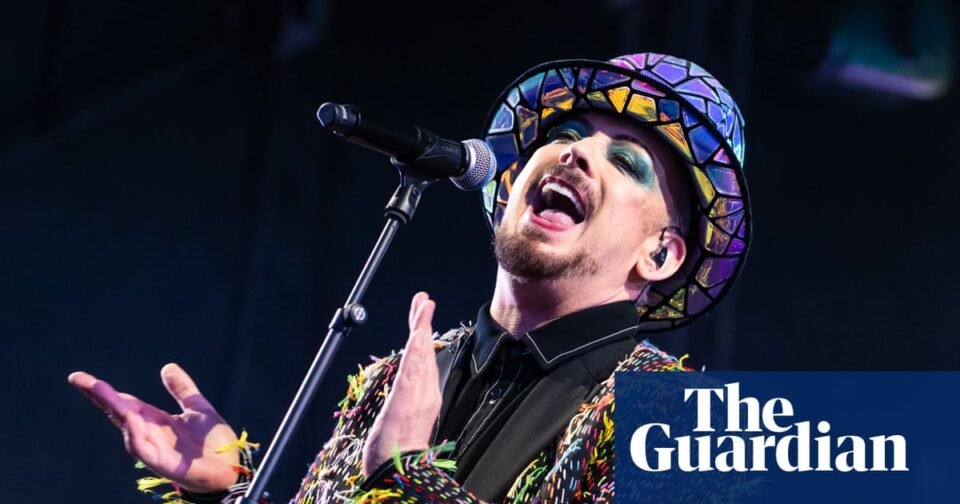
Boy George has pulled out of a forthcoming London production of Jesus Christ Superstar, days after he released a controversial song voicing support for Israel’s military action against Palestine.
The song, entitled עוד נרקוד alongside its English translation We Will Dance Again, addresses critics of Israel, whose military campaign has been been described as genocidal by a UN commission. “You say genocide, I say war / When you’re attacked, that’s what the army’s for,” read the lyrics. “Does it get ugly? You bet it does / When I know you wanna kill every last one of us.”
The singer’s manager Paul Kemsley wrote on Instagram that he had “decided, in my capacity as Boy George’s manager, that he will no longer be appearing in Jesus Christ Superstar at the London Palladium”.
He did not make specific reference to the new song, but added: “George has never been afraid to stand by his personal convictions, and I have always respected him for that. Equally, I believe it is my responsibility to make decisions that are in the best interests of my artist while also showing respect to others. In this instance, I felt it was right to step aside, allowing the production to remain the focus, while ensuring everyone involved can move forward with mutual respect and goodwill.”
Boy George was to have played King Herod in the Andrew Lloyd Webber and Tim Rice musical, which tells the story of the persecution and crucifixion of Jesus.
Kemsley apologised to ticketholders who hoped to see Boy George in the role, and thanked the show’s producers and creative team “for the professionalism and understanding they have shown throughout”.
With Eurovision star Sam Ryder as Jesus, the Herod role was being shared by five actors: Boy George, Julian Clary, Jesse Tyler Ferguson, Layton Williams and Richard Armitage, the last of whom will now cover Boy George’s performances.
Alluding to his departure from the production, Boy George posted an AI image of himself with a Groucho Marx moustache, and said: “To quote Groucho Marx I would never want to be part of any club that would have me as a member!”
Elsewhere in his new song, Boy George had criticised other musicians who voiced support for Palestine – “You condemn the Jews, with selective memory / Musicians holding flags, mouthing like sheep / Propaganda fuelled by the internet feels so weak” – and sang about the attack by Hamas on the Nova music festival at the outset of the war.
There were calls for protests outside the Palladium over his Jesus Christ Superstar appearances, and widespread condemnation of the song on social media.
Martyn Ware, one of Boy George’s 80s pop peers who was in the Human League and Heaven 17, described the song as an “overtly pro-genocide, anti-Palestinian piece of musical propaganda” and that Boy George should be “ashamed”.
Boy George responded to his critics on X, writing: “It doesn’t matter what I think or what you think. When will you realise you’re doing NOTHING! … I am even falling out with Jewish friends. The madness knows no bounds.”
On Threads he wrote: “I’m afraid we all struggle with the inability to live peacefully with each other. Until we do, we are doomed. I accept that many people disagree with my point of view but that is what is great about democracy. As imperfect as it is!”
The phrase “we will dance again” has been used by Israelis to voice resilience during the conflict, referring back to the dance music played at the Nova festival. Boy George added: “I saw the slogan ‘we will dance again’ and it resonated. Writing has to reflect the world we live in. Why not put the word ‘genocide’ in a song? Why are people suddenly uncomfortable with that word?”
He also said the reggae-backed song had been created with AI: “I call it ‘AI for good’. Truthfully, I would struggle to write this with a human!”
Boy George has frequently voiced support for the UK’s Jewish community, including after the knife attack on two men in Golders Green in April.
He also remained in the Eurovision song contest this year, as a guest artist in San Marino’s entry, after there were calls to boycott it over Israel’s inclusion. “I feel very connected to the Jewish people,” he said. “I’m not necessarily connected to Israel. I don’t really have an opinion on that. But the mission of music is to unite people.”