
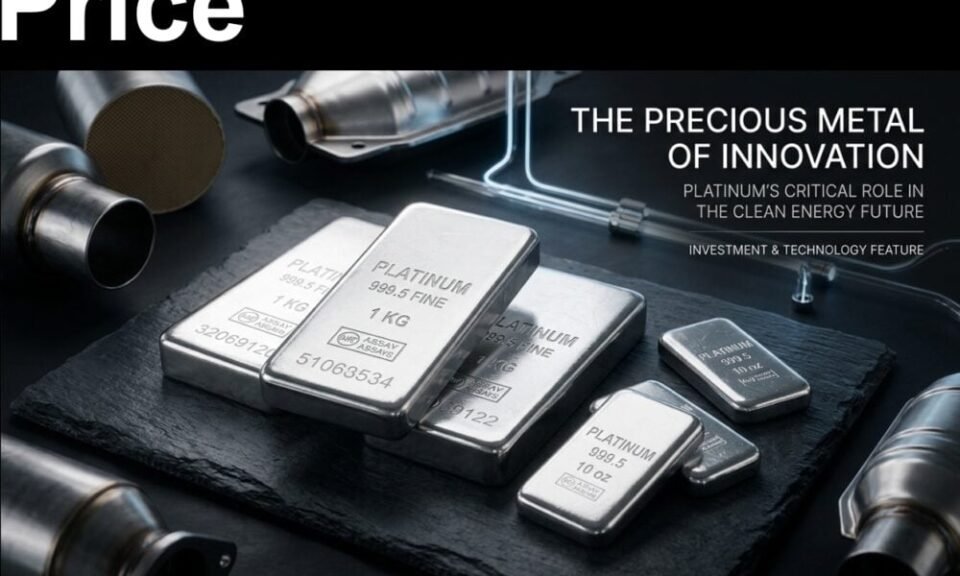
Platinum sits in the precious metals bracket alongside gold and silver, and that grouping is misleading in a way that costs people money.
Gold is bought largely because of what it represents. Platinum is bought largely because of what it does. That single difference explains most of how the two behave, and it means the questions worth asking about platinum are industrial questions rather than monetary ones.
Why the distinction matters before anything else
Treating platinum as a store of value leads directly to the wrong analytical framework. You end up watching real interest rates and central bank behaviour, which drive gold, while the actual determinants sit in vehicle production statistics and emissions legislation.
The practical test of any platinum price prediction is therefore whether it works through industrial demand, substitution economics and mine supply — or whether it simply extends a chart and gestures at precious metals sentiment. The second approach is common and it is not analysis.
What follows is the set of drivers a serious view has to account for.
The demand side is mostly industry
Platinum demand splits across four broad categories, and their relative weight shifts over time.
Autocatalysts. Emissions control in vehicles is the single largest industrial use. Catalytic converters require platinum group metals to convert exhaust gases, and platinum is particularly associated with diesel applications.
This makes demand sensitive to three things at once: total vehicle production, the diesel share of that production, and the stringency of emissions regulation in the major markets. Tightening standards raise loadings per vehicle; falling diesel share reduces total requirement. The two can move in opposite directions in the same year.
Jewellery. Substantial and highly price-sensitive. When platinum is expensive relative to gold, jewellery demand shifts; when it is cheap, it recovers. This makes jewellery a partial stabiliser rather than an independent driver.
Other industrial uses. Glass manufacturing, petroleum refining, chemical catalysis, electronics and medical applications. Individually small, collectively meaningful, and mostly inelastic — these users need the metal and will pay for it.
Investment. Bars, coins and exchange-traded products. The smallest category by volume in most periods, and the one capable of moving fastest.
Substitution runs in both directions
Platinum and palladium are technically substitutable in some catalytic applications, within limits and at engineering cost.
When one metal trades at a sustained premium, manufacturers have an incentive to reformulate toward the cheaper one. This is not instant — it requires development work and certification — but it happens, and it caps how far the two prices can diverge before economics reassert themselves.
Anyone modelling platinum in isolation, without reference to the palladium price, is missing a real constraint on the upside.
The hydrogen question, handled honestly
Platinum group metals are used in electrolysers that produce hydrogen and in the fuel cells that consume it. If hydrogen scales as a significant energy carrier, that represents genuine incremental demand.
The caveat matters as much as the claim. This demand story has been available for a long time and has consistently arrived more slowly than its advocates projected. Deployment depends on policy support, infrastructure investment and cost curves that have not yet resolved, and thrifting research aims to reduce loadings per unit.
It is a real long-term possibility rather than a near-term driver, and forecasts leaning heavily on it are making a policy bet rather than a metals bet.
Supply cannot respond quickly
The supply side is where platinum differs most sharply from a normal commodity.
Mine supply is geographically concentrated, and much of it comes from deep, capital-intensive operations with long development timelines. A price rise does not produce new supply for years. A price fall does not remove supply quickly either, because shutting a deep mine is expensive and often irreversible.
Platinum is also frequently produced alongside other platinum group metals and base metals. Production decisions are made on the economics of the whole basket, which means output can persist even when platinum alone looks uneconomic.
Recycling — principally from spent autocatalysts — is the genuinely responsive part of supply. It rises with price and with scrappage rates, and it is large enough to matter. It is also harder to forecast than mine output, because it depends on collection economics and vehicle fleet turnover.
The net effect is a market where demand can move in months and supply takes years.
The currency layer
Platinum is priced in dollars and mined substantially outside the dollar zone. Producer-country currency moves therefore change producer margins without any change in the metal price.
A weakening producer currency improves margins at a given dollar price, which supports continued output at levels that would otherwise be marginal. This is a real mechanism and it is routinely omitted from simple supply-demand models.
What this gives you, and what it does not
The drivers above are knowable. Vehicle production trends, emissions regulation, substitution economics, mine output and recycling flows are all researchable, and anyone building a view should be working through them rather than reading a chart.
What they do not give you is timing. A structural supply constraint can coexist with a flat price for an extended period if above-ground stocks are being drawn down, and investment flows can overwhelm fundamentals in either direction over months.
Platinum rewards people who understand catalytic chemistry, emissions policy and mining economics. It punishes people who assume it is gold with a different colour.
