
Ciudad del Rey Don Felipe was established on the north shore of Chile’s Strait of Magellan in 1584. When an English navigator came across it several years later, few survivors remained
/https://tf-cmsv2-smithsonianmag-media.s3.amazonaws.com/accounts/headshot/MicheleDebczak.png)
:focal(675x540:676x541)/https://tf-cmsv2-smithsonianmag-media.s3.amazonaws.com/filer_public/4b/0b/4b0b4057-b31b-44e7-a9c3-d6941c0370f7/651886194_18344737438242014_8401832748140664513_n.jpg)
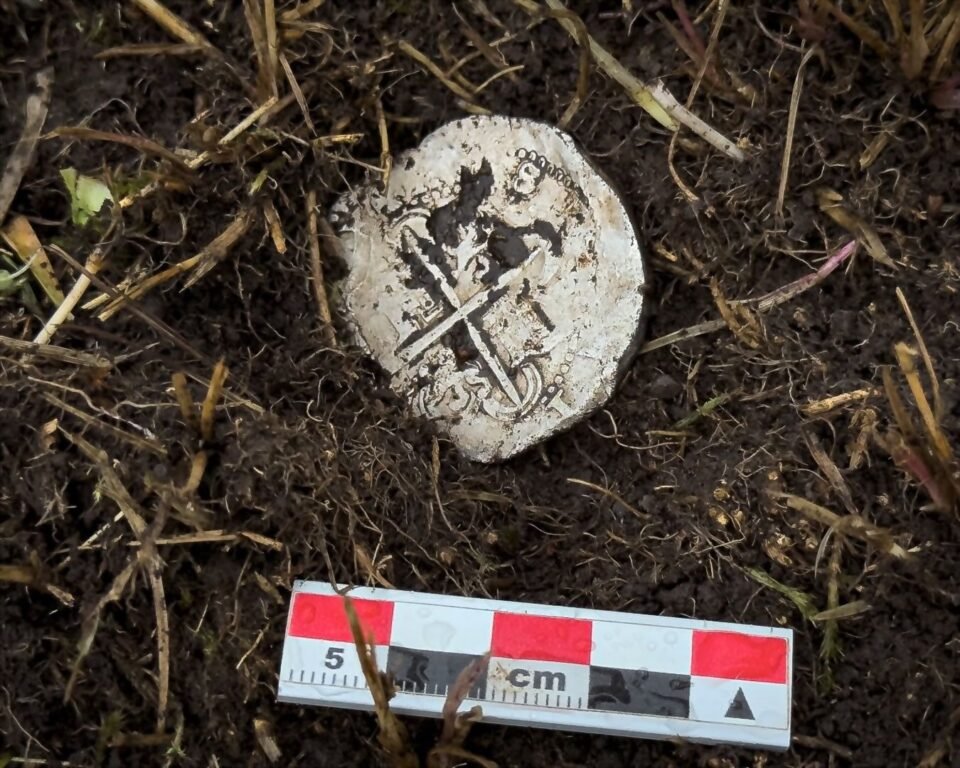
This coin was found near Chile’s Strait of Magellan.
Richard Bezzaza / Centro de Estudios Históricos y Humanidades
Spain had ambitious plans when it established a colony around Chile’s Strait of Magellan in the 16th century, but within a few years, both the settlement and the empire’s dreams had gone awry. The majority of the settlers at Ciudad del Rey Don Felipe—later dubbed Puerto del Hambre, or “Port Famine”—succumbed to starvation, the elements and various diseases. Much of what we know about the settlement comes from written records, but archaeologists recently made a significant physical discovery: a 400-year-old coin marking where it was founded.
The artifact was recovered as part of a collaboration between Soledad González Díaz, a historian at Bernardo O’Higgins University in Chile, and the country’s National Research and Development Agency.
While excavating the foundations of a settlement church in March, archaeologists discovered a silver coin left on one of the stones. The Spanish real de a ocho (piece of eight) backs up written accounts describing a Christian ceremony that marked the founding of the new settlement in 1584, when Spanish navigator Pedro Sarmiento de Gamboa established Ciudad del Rey Don Felipe on the north side of the Strait of Magellan. The coin features the insignia of Philip II of Spain.
Spain had ambitious plans when it established a colony around Chile’s Strait of Magellan in the 16th century.
/https://tf-cmsv2-smithsonianmag-media.s3.amazonaws.com/filer_public/d7/64/d7642dd9-3598-44ba-8535-0fa2ec959e58/strait_of_magellan.jpeg)
“This discovery provides a rare and powerful point of convergence between written sources and archaeological evidence,” González Díaz tells Live Science’s Tom Metcalfe.
Francisco Garrido, an archaeologist with Chile’s National Museum of Natural History who contributed to the research, adds, “Now we can know for sure that this is the place where the church was located, and from there, it is easy to know where all the other structures were built.”
Portuguese explorer Ferdinand Magellan forever changed world history when he sailed a passage connecting the Atlantic to the Pacific via Chile under the Spanish flag in 1520. When Spain’s king learned decades later that the British explorer Francis Drake had used this valuable route—plundering settlements in South America along the way—he sought to fortify both sides of the strait, protecting it from any enemy ships that might try to pass.
The project was marked with bad luck from the start. Spain sent around two dozen ships to the Strait of Magellan; just a few made it to their destination. Sarmiento de Gamboa forged ahead with the few hundred settlers who remained, but the conditions in southern Chile proved too harsh. When English navigator Thomas Cavendish arrived in the area a few years later, he found only a handful of survivors.
Did you know? Another doomed colony
- In 1587, more than 100 men, women and children left England via ship to found a permanent settlement in North America. Struggling in their new home on an island off the coast of present-day North Carolina, they sent a man back to England to procure supplies.
- But when he made it back in 1590, the colonists had disappeared. Several theories hypothesize what happened to the “lost colony” of Roanoke.
Historian Thomas Fuller described what the explorer discovered on the shores of the strait in his 17th-century book The History of the Worthies of England, writing, “Straits indeed, not only for the narrow passage, but many miseries of hunger and cold which mariners must encounter therein. Here Mr. Cavendish named a town Port Famine; and may never distressed seaman be necessitated to land there!”
The newly discovered coin is a fitting symbol for the so-called Age of Discovery, which saw European powers traverse the globe and attempt to dominate trade routes. Spanish pieces of eight—coins made from silver mined in Spain’s colonies in the Americas—were the “first global currency,” researchers Alejandra Irigoin and Bridget Millmore wrote in 2021. They circulated the world in the pockets of travelers and traders and were exchanged for items such as spices, textiles and tea.
In order to preserve as much of the historical site in Chile as possible, the research team working at Ciudad del Rey Don Felipe relied on noninvasive technology. They used metal detectors and geolocation tools to identify the underground stone where the coin was eventually found, making sure they had as much information as possible before they started digging.
“We detected a strong signal, but we didn’t know what it was until we carried out targeted excavations,” Garrido says, per Heritage Daily.
Now, with this new piece of information, they hope to map out the rest of the settlement and gain a better understanding of its brutal final days.