

“The auction courtroom is a microcosm of the stories of ordinary people.”

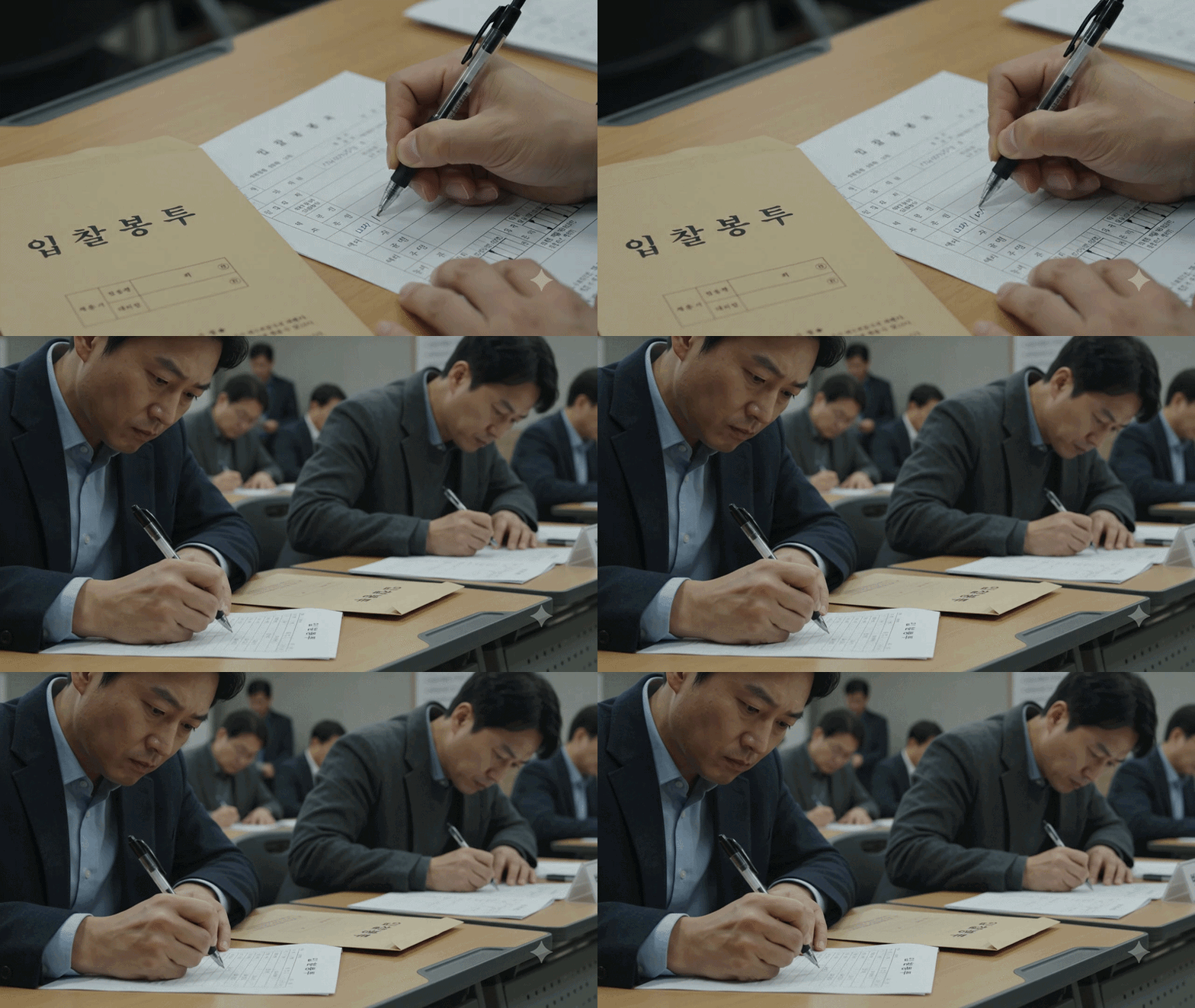
At around 10 a.m. on the 23rd, bidders were waiting for the auction to start at the Seoul Southern District Court auction courtroom in Yangcheon-gu, Seoul. As the bid opening began, the courtroom was once crowded with about 70 people. Photo by Jiye Lee
Around 11 a.m. on the 23rd, at Auction Courtroom 112 of the Seoul Southern District Court in Yangcheon-gu, Seoul. On this day, Mr. Yoo (55), who successfully bid on a neighborhood facility in Oryu-dong, Guro-gu, Seoul, with an appraised value of 1,878,990,000 won for 675,400,000 won, shared his story. This building had failed to sell five times at auction, causing the minimum bid price to fall to 615,710,000 won. Mr. Yoo, who said he traveled from Gwangju to participate in the auction, commented, “I’ve made decent profits several times through auction investments,” and added with satisfaction, “For this building, I plan to realize a profit by selling it after reconstruction.”
“I came here hoping to recover at least some of my losses from the jeonse fraud, even through auction.”

On the morning of the 23rd, bid documents received by a bidder at the auction court of the Seoul Southern District Court in Yangcheon-gu, Seoul. Auction bid prices are kept confidential until the bid opening. Photo by Jiyé Lee
There were also people who came to the auction court for more urgent reasons. Ms. Cho (36), who seemed unfamiliar with the process and kept checking her documents, asked the reporter, “Is this the right way to fill out the form?” She explained that she lost a deposit of 160,000,000 won due to a jeonse fraud and participated in the auction for the home she had been renting. “If I successfully win the auction for the house that went to auction, I think I might be able to recover at least part of my losses, so I came to the court for the first time,” she said.
“Reality is much harsher than I expected.”

The over 70 people who filled the courtroom, each with their own purpose, engaged in an intense psychological battle. There was a middle-aged woman who came to look at a villa as a wedding gift for her son, young people hoping to secure their first home through an auction, and investors aiming for profit. Mr. Kim, in his 60s, who has distributed auction information magazines for over 30 years, said, “Today, there are fewer people because there are not many properties, but on popular days, hundreds of people cram into the courtroom.”
Sharp Increase in Number of Auction and Public Auction Ownership Transfer Registrations
Source: Court (actual ownership registration)
Compiled by: Court Registry Information Plaza
As people seeking asset growth and those searching for a breakthrough to housing stability all gather in one place, the court auction hall has come into the spotlight as a microcosm of the real estate market. Unlike in the past, when court auctions were seen as a niche investment opportunity because the land transaction permit system (which requires actual residency) did not apply, the market has recently shifted to focus primarily on non-homeowners aiming for their first home, after the implementation of higher taxes for owners of multiple properties. However, there are concerns that polarization is appearing even in the auction market, as bidders with sufficient funds have an advantage due to continued lending restrictions.
According to the Court Registry Information Plaza as of June 26, the number of applications for ownership transfer registration by auction or public auction reached 5,328 as of May this year. Compared to 3,300 in 2022, this represents a sharp 61.5% increase over four years. The annual figures were 3,141 in 2023, 4,137 in 2024, and 4,635 last year, showing a steady upward trend. On the day the reporter visited the auction court, six bidders competed for a villa in Doksan-dong, Geumcheon-gu, Seoul, which was slated for redevelopment, and the winning bid was 310,340,000 won. This was 47,340,000 won higher than the appraised value of 263,000,000 won, resulting in a winning bid ratio (winning bid/appraised value) of 118.0%.

Court auctions are held by having each bidder write down their desired price on paper and submit it confidentially, with all bids opened at once. The person who writes the highest price wins, making for a fiercely competitive process. Once a bid is submitted, it cannot be modified or withdrawn. Mr. Lee, in his 60s, who participated in a vehicle auction, bid 29,100,000 won on a Kia Sorento with a minimum bid price of 24,800,000 won, but could not smile even after hearing that he had won. Despite bidding high, he was the only bidder. He said, “Last time, I lost out to someone who bid even higher, so this time I bid 5,000,000 won more. But today, my strategy totally failed,” he said, closing his eyes in disappointment.

Ms. Han Yeryeong (28), who runs the 2030 Real Estate Community, is showing her social networking service (SNS) account. Known as “Lena,” Ms. Han introduced that the community she operates has reached 1,500 members. Photo by Jiye Lee
Of the 72 properties auctioned that day, only 15 actually had bidders. The number of bidders per property ranged from one to six. Many who filled the courtroom were “auction tour” participants who came to observe and learn. Hyeryeong Han (28), who runs a real estate community, said, “As the number of jeonse listings decreases and uncertainty grows that prices will keep rising, people are seeing auctions as an alternative way to secure a home. The youngest student in my class was born in 2004.” Math instructor Ms. Yeo (52) shared, “I started learning about auctions on YouTube, but I came here in person because I was curious about the atmosphere.”
Auction Market Capital Gap and Risk Factors
Entry of Non-Homeowners with Real Demand Amid Loan Restrictions
BarrierNonHomeowners
Real Demand Buyers’
BarrierGovernment
Ongoing Loan Restrictions and Higher Thresholds for Auction Balance Loans
* Banks factor in senior claims and tenant deposits, in addition to the winning bid price
Inevitable Capital Gap
GeneralPublic
As direct purchases become difficult, people turn to auctions, but their hands are tied
Professional
Risk Factors
Unexpected encumbrances, such as lien rights, may arise depending on the legal status of the property
* The expectation that properties are always cheap is misguided
The problem is that as more people flock to the auction market, the capital gap is widening. While those who find it difficult to enter the general sales market are turning to auctions, continued government lending restrictions have left many unable to act. Non-homeowners with real demand, who need to rely on loans, find it especially hard to actually participate in bidding. This is due to the higher threshold for “auction balance loans,” which are used by winning bidders to pay the remaining amount. Banks determine loan limits not only based on the winning bid price, but also by factoring in senior claims and tenant deposit protections.
Mr. Yoo, who won the Oryu-dong neighborhood facility auction, noted, “From my experience, loan restrictions are causing overall competition and winning bid prices to fall. Won’t even tenants who couldn’t recover their deposits suffer losses in this environment?”
Several experts have observed that as long as loan restrictions remain, the capital gap in the auction market is inevitable. In particular, they warn that unexpected burdens, such as lien rights depending on the property’s legal status, can arise; thus, it is risky to approach auctions solely with the expectation of purchasing below market value.
Kang Sungjin, professor of economics at Korea University, said, “Just like in the real estate market, the more the government tightens lending, the more those who need to borrow money suffer. Since the policy is intended to manage household debt, it will be difficult to relax regulations solely for the auction market.” Kang Insu, professor of economics at Sookmyung Women’s University, commented, “It’s positive that people are showing interest in the auction market as a way to secure a home, but it is essential to carefully evaluate one’s financial capacity and situation, and to approach only after thorough preparation.”

Meanwhile, a recent incident at the Seoul Southern District Court saw a Yeongdeungpo Art Xi apartment (exclusive area of 143㎡) with an appraised value of 1,880,000,000 won being sold at auction for 17,296,000,000 won. It was reported that the bidder intended to write 1,729,600,000 won, but accidentally added an extra zero. If the bidder forfeits the winning bid, approximately 150,000,000 won in deposit will be lost. The buyer submitted an objection and a petition against the sale approval, but reports indicate these were not accepted.
-

Reporter Lee Jiye easy@asiae.co.kr
-
Edit Lee Seonju sjlee109@asiae.co.kr
© The Asia Business Daily. All rights reserved. Unauthorized AI training and use prohibited.