

Information has always played an important role in residential real estate.
Buyers evaluate listings, compare neighborhoods, review disclosures, analyze inspections, and assess financing options before making one of the largest financial decisions of their lives. Yet despite the enormous amount of information available throughout the homebuying process, many consumers still feel uncertain about what ownership will actually look like after closing.
That uncertainty is helping drive a growing demand for housing transparency.
As buyers navigate elevated housing costs, insurance volatility, maintenance expenses, and long-term affordability concerns, many are seeking greater visibility into the characteristics that may influence ownership experience over time.
The trend reflects a broader shift already taking place throughout the housing market.
As explored in Why Homebuyers Want More Information Than A Listing Can Provide, traditional listings often struggle to communicate many of the factors buyers increasingly want to understand before making a purchase. Information about system condition, maintenance history, operational characteristics, and long-term ownership expectations is often difficult to assess through listing descriptions alone.
The same dynamic is influencing how buyers evaluate homes more broadly.
As discussed in What Home Inspections Still Don’t Tell Buyers About Long-Term Ownership, inspections provide valuable information about a home’s observable condition but are not designed to fully explain how ownership may unfold over the years ahead.
As a result, buyers are increasingly looking for information that helps reduce uncertainty.
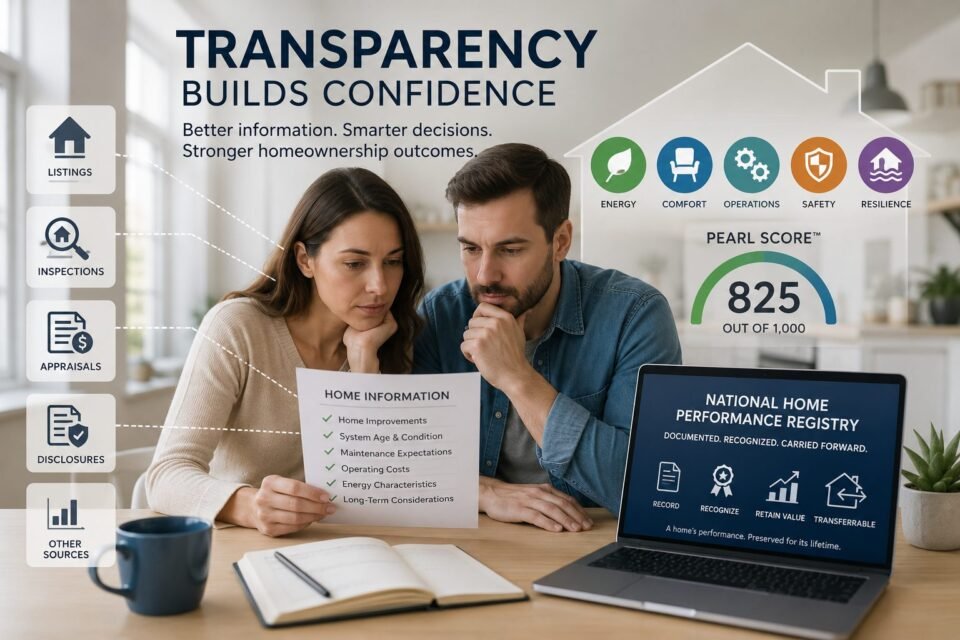
Many consumers want greater visibility into:
- Home improvements and upgrades
- System age and condition
- Maintenance expectations
- Operating costs
- Energy-related characteristics
- Long-term ownership considerations
This growing demand for transparency is creating new opportunities throughout residential real estate.
For buyers, access to more information can support greater confidence during the decision-making process. For sellers, documented improvements and property information may help communicate value more effectively. For housing professionals, transparency can help facilitate more informed conversations around ownership expectations and long-term affordability.
The growing emphasis on transparency also reflects the increasing number of information sources buyers use when evaluating homes. The National Association of Realtors’ Consumer Guide: The Appraisal Process highlights how appraisals provide additional information that can help buyers better understand a property’s value and characteristics before completing a transaction. Increasingly, buyers are looking to combine insights from listings, inspections, appraisals, disclosures, and other sources when making purchasing decisions.
The concept extends beyond simply providing more data.
Increasingly, buyers want information that is organized, understandable, and relevant to how homes may function after closing. The goal is not information for its own sake, but information that helps consumers make more informed decisions.
That shift is contributing to growing interest in standardized approaches to home performance information.
As housing decisions become more data-driven, buyers increasingly want information that helps explain how homes may perform over time. Pearl SCORE™ organizes information about a home’s Energy, Comfort, Operations, Safety, and Resilience, then rates the home’s overall performance on a 1–1,000 scale. That gives buyers a consistent standard for comparing the homes on their shortlist.
Broader industry efforts are also working to improve the visibility of home information over time.
Pearl’s recently announced National Home Performance Registry is designed to give a home’s documented performance lasting standing throughout its lifecycle — so the energy upgrades, efficient systems, and resilience work owners invest in are recognized and carried forward rather than lost between transactions. More than a place to keep records, it establishes a consistent way for home performance to be measured, recognized, and compared across the market — reflecting a broader shift toward treating performance as a core part of a property’s value.
The focus on transparency also aligns with broader changes in buyer behavior.
As discussed in Why Buyers Are Starting To Ask Different Questions About Homes, many consumers are increasingly evaluating homes through the lens of ownership predictability rather than purchase price alone. Questions about maintenance, operating costs, efficiency, resilience, and long-term affordability are becoming larger parts of the homebuying conversation.
The result is a marketplace where transparency itself is becoming increasingly valuable.
Buyers still care about location, aesthetics, and price. But they also want greater confidence in how a home may perform, what ownership may require, and what factors could influence long-term costs after the transaction is complete.
As housing markets continue evolving, the ability to provide clear, accessible, and meaningful information may become one of the most important differentiators in residential real estate.