
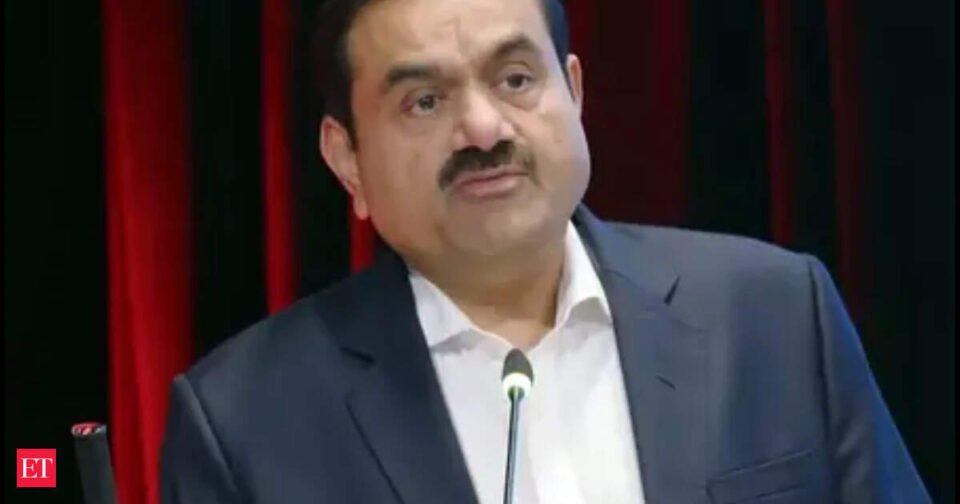
Delivering the keynote address at the CareEdge Group Annual Summit in Mumbai, Adani said India did not need lower rating standards but needed “wider lenses” to assess a new generation of infrastructure projects that create capabilities and ecosystems beyond their standalone cash flows.
Also Read: Gautam Adani meets DK Shivakumar amid delay over Bengaluru tunnel road project
“Transformational infrastructure can be constrained not only by a lack of ambition or capital, but also by the frameworks through which its risks are assessed,” he said.
He added that the development of several analytical frameworks took place at a time when demand was relatively visible and the boundaries of an asset were easier to define. Apart from using the discounted cash flow model, these ratings often also isolated assets from their environment.

“India has now entered a very different period. The nature of infrastructure has changed, and the sophistication of our rating frameworks must evolve alongside the sophistication of what India is building,” Adani said.
Drawing on his experience of building Mundra Port, Adani said conventional single-asset discounted cash flow models could not adequately capture the value created when infrastructure assets become interconnected platforms.Mundra, which began as a port project on a marshy coastline with limited surrounding infrastructure, eventually developed into a wider ecosystem linked to railways, logistics centres, power plants and industrial zones, he said.
Also Read: US court scraps fraud case against Gautam Adani and nephew Sagar
“Today, Mundra is easily one of India’s most important commercial gateways. But more importantly Mundra has created an ecosystem multiple times the size of the port,” Adani said, adding that it is a port connected to rail, rail connected to logistics centres, logistics connected to power plants, power connected to industrial zones and industrial zones connected to traders and manufacturers all across India.
“Mundra proved that platform infrastructure operates as a multi-layer network where each new layer cross-subsidizes, feeds, and de-risks the other,” Adani said, arguing that such economic compounding was difficult for linear financial models to capture.
He also cited the Vizhinjam port project in Kerala, which he said was strategically important for India despite facing difficulties in meeting conventional financial and risk assessment parameters.
India, located close to some of the world’s busiest shipping routes, had for decades depended on foreign ports such as Singapore, Dubai and Colombo for container transshipment, Adani said. Vizhinjam was built despite concerns over engineering complexity and capital risk and became the fastest Indian port to handle two million TEUs within 18 months.
“Conventional credit models correctly measure execution risk. But, in strategic infrastructure, we must also learn to recognise the economic value of sovereign resilience,” Adani said.
Turning to the group’s 30-GW renewable energy project at Khavda in Gujarat’s Rann of Kutch, Adani said the project should not be assessed merely as a power-generation asset.
Khavda represents a larger platform where renewable energy, artificial intelligence, manufacturing, digital infrastructure and industrial capability could converge, he said. The project could provide clean energy for India’s future computing infrastructure and support the development of an AI manufacturing ecosystem.
“Measured simply as a power project, Khavda will be under-rated for decades. But when measured as a transformational platform, it will be one of India’s most important strategic assets,” Adani said.
Adani also highlighted the growing link between artificial intelligence and physical infrastructure, saying the future competitiveness of AI would depend not just on software and algorithms but also on the ability to build data centres, cooling systems, transmission networks and large-scale supplies of clean and reliable electricity.
“AI may look like software. But, ultimately, AI runs on infrastructure,” he said, adding that infrastructure required for India’s development would need both ambition and institutional trust.
“The India of 2047 will not be built by ambition alone. It will be built when ambition earns trust, when trust unlocks capital and when capital builds national capability,” Adani said.