
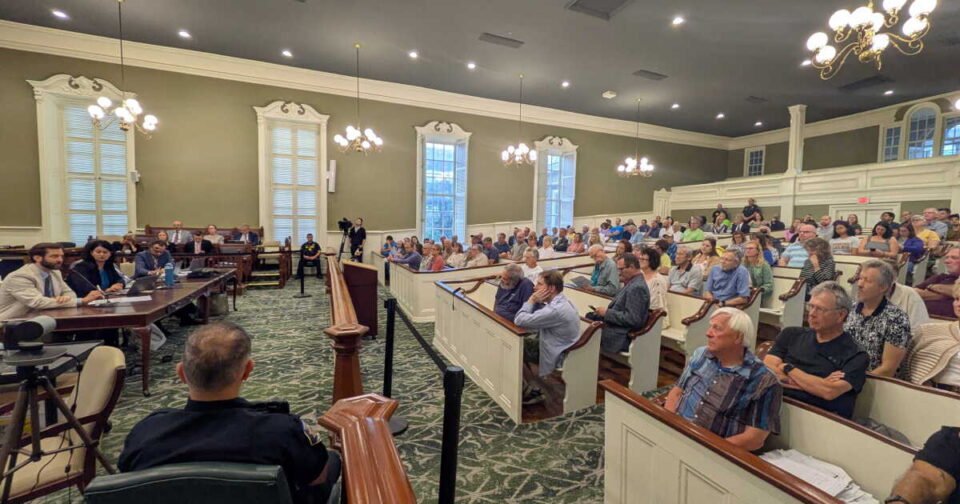
ALLENTOWN, Pa. — Lehigh County Commissioners conducted a public thought experiment Wednesday night — what if the county revived its intangible personal property tax?
More than 120 people showed up at the Historic Lehigh County Courthouse, most of whom were eager to give commissioners a piece of their minds.
A clear majority of the crowd was openly hostile to the concept, which some have pitched as a wealth tax.
County Executive Josh Siegel was interrupted by boos and heckles when he tried to call modern America a period of robber barons.
Steven Herzenberg, an economist with the Keystone Research Center, drew scoffs when he testified the county could raise at least $120 million, though the county raised just $2.5 million when it last collected the tax in 1992.
“The vast majority of people would pay less if the county creates a 4-mill [intangible personal property] tax,” Herzenberg said to grumbles.
Commissioner Ron Beitler, one of the loudest critics on the board, said 94 of the 95 letters and emails sent to the commissioners’ office ahead of the meeting were opposed to restoring the tax.
“This is not about taxing billionaires, it’s about putting a new tax on the people it would claim to help.”
Mathew Mull, Lower Macungie Township
The loudest critics Wednesday night had left by the time public comment began two hours into the hearing, but still, most who spoke were opponents of the concept.
“This is not about taxing billionaires, it’s about putting a new tax on the people it would claim to help,” said Mathew Mull of Lower Macungie Township.
By the end of the night, four commissioners from across the political spectrum — Democrats Geoff Brace and Dan Hartzell, Republican Antonio Pineda and Beitler, an independent — said they would not support the measure if formal legislation ever reached the board.
Hartzell said the requirement to apply the tax evenly along all assets regardless of the owner’s level of wealth would hamstring too many seniors on limited incomes, including his own 94-year-old mother.
“When I apply these numbers to what she has, she gets hit pretty hard,” Hartzell said. “Bottom line is, I don’t think this is the way to do it, and certainly not now.”
Three others — Democrats Sarah Fevig, Jon Irons and April Riddick — expressed a willingness to explore the concept given the county’s financial constraints but stopped short of endorsing any legislation.
Riddick said cutting spending, at a time when federal government was cutting its support for critical services, was not a reasonable option.
“Is this the best idea? Maybe not. But it frightens me that we may need to cut back on services like mental health,” she said.
Commissioner Sheila Alvarado did not attend the hearing. Commissioner Zach Cole-Borghi attended virtually but did not comment; the meeting was plagued by technical issues, and it was not clear if he could hear the proceedings.
While more than 60 people attended the hearing virtually, only two managed to provide feedback by the time the meeting ended shortly after 10 p.m.
The large turnout required county officials to move the committee hearing from the commissioner’s meeting room in the County Government Building to the Historic Lehigh County Courthouse. County staff speculated after the hearing that a white-noise system that allows for private sidebar discussions in the courtroom may have garbled online audio.
‘Keep your hand out of my pocket’
Lehigh County Controller Mark Pinsley floated the idea of reviving the county’s intangible personal property tax in a report last month. He said commissioners need to explore ways to close the county’s $3.7 million structural deficit that’s only projected to grow in the years ahead.
“We are evaluating a revenue tool to determine if this could be used to fund the services the county provides.”
Lehigh County Commissioner Sarah Fevig
For more than 30 years, Lehigh County has predominantly relied on property taxes and user fees to generate local revenue, but that process places an unfair burden on working class families.
Targeting intangible properties — which include secondary homes and rental properties, stocks, bonds, mutual funds, and S corporations among others — would place a greater portion of the burden on the region’s wealthiest residents, Pinsley said in the report.
He contended the board had an obligation to explore the idea more deeply, saying it could shift taxes onto households that could better afford it.

Tom Shortell
/
LehighValleyNews.com
Fevig, chair of the board’s finance committee, took him up on the idea and pitched the hearing as a thought experiment.
She emphasized Wednesday that no tax was under serious consideration; Siegel would not include the intangible personal property tax in his upcoming 2027 budget proposal and no commissioner had any intention of proposing one by the end of the year. Commissioners were attempting to be transparent and include the public in an open dialogue on an intriguing policy, she said.
“We are evaluating a revenue tool to determine if this could be used to fund the services the county provides,” she said at the hearing’s outset.
Those assurances did little to curb the criticism. The loudest applause of the night may have gone to Asher Schiavone of the Greater Lehigh Valley Realtor’s Association, who was invited to testify as an expert witness.
Schiavone argued that bringing back the tax would raise housing costs. The tax would apply to rental properties, and the cost of the tax would likely be passed to renters, he said. It’s possible the complexities of the tax may be onerous enough for smaller landlords to sell their properties, which would increase the likelihood of corporations acquiring more properties.
He appreciated the county needed to address its structural deficit but said the commissioners’ thinking was misaligned.
“I would hope that overspending by $3 million sounds like an expense problem, not a revenue problem,” Schiavone said to cheers.
Throughout the night, members of the public echoed those remarks. They said the government needed to act responsibly or be held accountable, and the tax would encourage people to move over the county line into Berks County and push wealth out of the area.
“‘Keep your hands out of my pocket,’ is the biggest thing for me,” said James Rieger of Emmaus.
‘People deserve real numbers’
But while those speakers’ tax bills have undoubtedly grown in recent years, Lehigh County’s leaders have not contributed to the problem. County property tax rates are lower today than they were 13 years ago. The board of commissioners passed a series of small tax cuts in the early 2010s. While the county did raise taxes in 2019, commissioners haven’t completely rolled back those tax cuts.
Commissioners unanimously repealed the intangible properties tax in 1992 in part because the tax was difficult to collect. The county does not have access to IRS returns, leading some to call it an “honesty tax” because it relied on self-reporting.
While the county may be able to collect tax returns from the state, Commissioner Antonio Pineda said, the county should expect high start-up costs and expensive litigation on a tax that no Pennsylvania county has attempted to collect in more than 25 years.
After the hearing, Fevig called the experiment a success. It was her goal to collect feedback and the perspectives of the public and the hearing served as democracy in action.
She cited the testimony of Sean Lasalle, who pointed out the tax would hit accounts he’s created for his nephews. He managed to raise $9,000 for each boy through a GoFundMe after their father died. Through savvy investments, he’s grown that to $32,000 for each nephew, money meant to give the boys some financial support that his late brother could no longer provide.
“That, to me, is not setting someone else up for success,” Lasalle said of taxing the investments.
Fevig said she does not expect to explore the tax more in the near future.
“I want to digest everything that happened tonight. To me, the conversation was deeply moving,” she said.
Pinsley, who did not offer public comments during the hearing, thanked commissioners for following through on his request to start a dialogue on the proposed “wealth tax.” He said it was important for commissioners to learn there are many people who strongly support keeping the tax structure the same but encouraged lawmakers to keep digging deeper.
“I think people deserve real numbers, not fear or rumors or misinformation.”
Mark Pinsley
At this early stage, it’s not clear whether most taxpayers would owe less if the county readopted its intangible personal property tax, he said. Public opinion may shift if officials can provide better information, he said.
“I think people deserve real numbers, not fear or rumors or misinformation. Once they know if they will pay more or less under different options, then they can make a better decision about what is fair and what is not,” he said.