
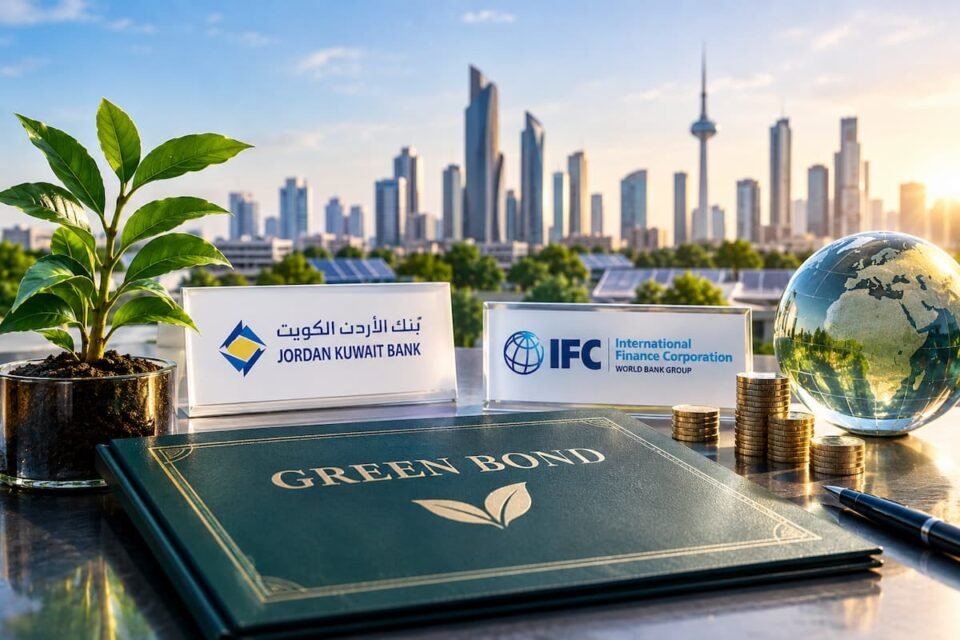
Jordan Kuwait Bank (JKB) has issued its second Green Bond, with the International Finance Corporation (IFC) committing up to USD 100 million as anchor investor. The Amman-based lender, which holds total assets of approximately USD 7.70 billion, first entered the green bond market in 2023 in what IFC described at the time as Jordan’s inaugural sovereign-adjacent green bond issuance. The second transaction builds on that structure and widens the eligible asset pool.
Proceeds will be allocated across renewable energy, energy efficiency, blue finance, certified green buildings and sustainable transport. The issuance carries alignment with the International Capital Market Association‘s Green Bond Principles and sits inside JKB’s own Green Finance Framework, both of which impose disclosure and use-of-proceeds reporting requirements that distinguish labelled green bonds from standard bank debt.
Blended finance mechanics

A notable structural feature is the performance-based incentive attached to the transaction through the IFC-UK Market Accelerator for Green Construction (MAGC), a blended finance programme funded by the UK Department for Energy Security and Net Zero. MAGC is designed to de-risk lending toward certified green buildings in emerging markets, meaning a portion of the return profile for JKB is contingent on verified green-building outcomes rather than being fixed at issuance. This is a relatively sophisticated structure for a MENA bank of this size and signals that IFC is using the transaction as a demonstration vehicle for the wider region.

Haethum Buttikhi, group chief executive officer of Jordan Kuwait Bank, said the issuance “will mobilise capital towards projects that generate meaningful environmental and economic impact, while supporting the Kingdom’s Economic Modernisation Vision.” Momina Aijazuddin, IFC’s regional industry director for financial institutions, noted the partnership aims to support job creation and accelerate sustainable growth in alignment with Jordan’s national economic strategy.
Market and regulatory context
Green bond issuance across the Middle East and North Africa has grown steadily since 2021, though Jordan remains a smaller market than the UAE or Saudi Arabia, where sovereign and quasi-sovereign issuers have driven volume. JKB’s transaction is noteworthy precisely because it is bank-led rather than sovereign-led, pointing to a gradual deepening of the domestic capital market beyond government paper.
The deal aligns with the Central Bank of Jordan‘s Green Finance Strategy, which provides a regulatory framework for sustainable lending at the institutional level. For investors, compliance with ICMA Green Bond Principles provides a degree of independent verification and reduces the risk of greenwashing exposure, a concern that has prompted tighter scrutiny from regulators in the EU and, increasingly, across Gulf financial centres including the DFSA in Dubai and the ADGM in Abu Dhabi.
For regional banks watching this transaction, the IFC anchor structure matters as much as the environmental label. Development finance institution participation lowers the effective cost of capital and provides a reputational imprimatur that can help smaller issuers access international institutional buyers who would otherwise require a higher risk premium. Whether JKB can repeat this structure without IFC support on a third issuance will be the more telling test of whether the Jordanian green bond market has developed sufficient standalone depth.
AI level 1 of 5: written by Darlyn Ho; AI helped with tone, structure or wording; edited and signed off by Mark Walker, Editorial Director. What the levels mean